
April 5, 2026
Attaining the Resurrection
An Easter message from Philippians 3:1-11 built around one question: where have you placed your confidence? Pastor Rich shows that false confidence — trusting our own effort, religion, or self-help to reverse the curse of sin and death — is utterly futile, and that even Paul, with the most impressive religious resume imaginable, counted it all as loss. True, joyful confidence rests entirely in the resurrected Jesus: knowing Christ is of such surpassing worth that everything else is rubbish by comparison (pictured by a bar of gold that becomes deadly weight to a drowning man who needs a life vest). To know Jesus is the very definition of eternal life and the heart of revival — a single holy passion to know Him and the power of His resurrection, which frees us from enslavement to sin now and guarantees the future resurrection of our bodies. Because Christ died and rose, believers can rejoice always, even amid the curse, for death no longer has the last word.
I trust your heart reverberates with joy as we say that together. There is going to be a day when we join the anthem of the angels, every tribe and every tongue, every nation. What a day. But for now, we get to do that together here at Bethany this morning, just join together with our hearts saying, "Jesus made all the difference. He brought me life," and we want to praise him for that. Amen? So we're going to open up our Bibles together to Philippians 3, and please remain standing as we read verses 1 through 11. I've chosen this for our Easter text. It's a little bit unusual for an Easter text, but it kind of captured my heart as I was thinking about what to share on this morning, a morning when we celebrate the resurrection of Jesus. And really every Sunday is a celebration of his resurrection.
Easter just happens to be, let's lock in and think about those last hours of Jesus' life, and then that third day when darkness turned to light, where despair became absolute hope and guarantee and promise. So we're going to look at Philippians 3. If you don't have a Bible, there should be a Bible under a chair or seat near you, and it'll be helpful for you to follow along. Well, in the message, we're going to kind of follow along through these first 11 verses here together. Let me read the word of the Lord. "Finally, my brothers, rejoice in the Lord. Now to write the same things to you is no trouble to me, and it's safe for you. Look out for the dogs, look out for the evildoers, look out for those who mutilate the flesh. For we are the circumcision, who worship by the Spirit of God and glory in Christ Jesus and put no confidence in the flesh, though I myself have reason for confidence in the flesh also. If anyone else thinks he has reason for confidence in the flesh, I have more: circumcised on the eighth day, of the people of Israel, of the tribe of Benjamin, a Hebrew of Hebrews; as to the law, a Pharisee; as to zeal, a persecutor of the church; as to righteousness under the law, blameless. But whatever gain I had, I counted as loss for the sake of Christ. Indeed, I count everything as loss because of the surpassing worth of knowing Christ Jesus my Lord. For his sake I've suffered the loss of all things, and I count them as rubbish, in order that I may gain Christ and may be found in him, not having a righteousness of my own that comes from the law, but that which comes through faith in Christ, the righteousness from God that depends on faith— that I may know him and the power of his resurrection, and I might share in his sufferings, becoming like him in his death, that by any means possible I may attain the resurrection from the dead."
May God encourage us through his word today. Please be seated. And we're going to pray together and ask God to meet with us and speak to our hearts. God, I pray this morning if you've joined us here at Bethany, I pray that you experience the love of Jesus for your life and your soul. I pray you experience the love of Jesus Christ through our singing, as we sing these gospel words, that you think about how much God loves you. I pray that you experience the love of Christ through our praying, that we can call it Abba Father and talk to him. And I pray that you experience the love of Jesus through the teaching of his word this morning, and then afterwards, the fellowship of the saints. This is the center. God loves you. Do you know that?
And he sent his Son, Jesus, to die for you, and that Son rose again from the dead to guarantee life to everyone who comes to him. Let's pray. Father, I thank you for your great love for us. I thank you that your love is so high, so wide, so deep, so long, that we could really never comprehend it fully. We have so much more to experience. We've tasted a bit, and we long for more. We desire to know Jesus, our Messiah, the one who received the punishment that our sins deserve so that we could be forever free, free from the fear of your judgment, who then rose to life so that we could live a new life, so that we could be transformed into the image of your Son. Lord, help us to receive all the benefit of his life in us today. I pray, oh Father, that we'd be of a kind of people who would count everything to be loss. Help us, Lord.
You know our propensity to grab onto things, things of this world, and to value them, and help us to count everything as really garbage, as rubbish, when we put it next to the surpassing worth of knowing Jesus. So Father, we pray for revival in our hearts. We pray for revival in our church, revival in our country. Lord, I want to thank you specifically for an answered prayer as Friday night when we gathered here on a Good Friday service, we prayed for this airman who was downed and behind enemy lines. We prayed that you would liberate him. And Lord, this morning, I just wanted to thank you publicly and together that you heard our prayers. You heard the prayers of many of your people, and you did something that really is amazing, Lord, for that individual and for his family and for those brothers and sisters along whom he serves. I do pray, Lord, that you'd put an end to evil. We long for the day when Jesus returns and ultimately evil is put away. But Lord, I pray for the people of Iran.
I pray that you would liberate them from oppressionAnd Lord, I pray that you would bring protection and safety to the men and women who serve us in the military. Thank you, Father, for your word. Thank you for your Spirit. I pray, oh Father, that we would have ears to hear what your Spirit would say to us this morning. So please, Lord, grace us and nourish us. In Jesus' name, amen. Amen. So I grew up next to a boy named Brian, who was about my same age, and we were really great friends. We explored the woods. We seined the stream for minnows and crawdads.
We rode mini bikes. We played basketball, kicked the can. We threw apples at each other. We knocked down wasp nests. We wrestled. We caught snakes. We did all things that boys do. Both Brian and I were raised in Christian homes. We shared that as well. And from an early age, we talked about a lot of things together.
And so when we were about six years old, my friend Brian looked over at me, and sort of out of the blue, he said, "You know, my dad could take your dad." "What?" I said, "No, he can't." He said, "Yes, he can." I said, "No, he can't." I felt I needed to defend the honor of my dad. We just argued back and forth. "Yes, he can." "No, he can't." "Yes, he can."
And on it went back and forth without any real resolution to the issue. Well, looking back though now at this stage in my life, I think my confidence might have been misplaced. My dad was neither muscled nor was a brawler. I don't know if he ever got in a fight in all of his life. His job was inside of a savings and loan, and he worked to sort of audit the books. So he didn't exercise his muscles in his work, and I never saw him lift a weight. Brian's dad, on the other hand, he worked construction. So every day he was out there working construction, and then when he'd get home, I'd often see him in his garage pumping iron. So from this standpoint, I think Brian might've been right. But I don't think it did me any harm to believe in the toughness of my dad at that moment.
Now, sometimes, however, misplaced faith, misplaced confidence can be catastrophic. So misplaced confidence in a faulty plane will end up in a crash with everyone dying. Misplaced confidence in a drunken surgeon will end in disaster for your body. And misplaced confidence in a weak savior, a false gospel will place us in hell forever and ever. And so in your relationship with the Lord, I want you to think this morning, where have I placed my confidence? Because misplacing your confidence in this arena, the arena of your soul, is absolutely catastrophic. It's eternally catastrophic. What am I counting on the day that I stand before God to give an account? What am I counting on? What am I trusting in to have Him say those words, "Welcome, enter into my kingdom. Enter into my joy"?
Well, this morning, we're going to look at this main idea, a Christian is one who puts all his or her confidence in the resurrected Jesus. We realize that we have nothing in ourselves to bring to that equation, that we can't place any confidence in ourselves, and we place 100% confidence in Jesus because He is a worthy savior. He died, and He rose again. And then we, as Christians then, we long to experience the knowledge of Jesus, to know Him personally, and we long to experience the power of His resurrection at work in our lives. We look for Jesus to bring us new life right now, and then a resurrection that brings wholeness and completeness forever and ever. So that's who we are as believers. So this morning, the Apostle Paul in Philippians chapter three is going to talk about confidence. He's going to talk about a false confidence, then he's talking about a true confidence. A false confidence is absolutely futile, and that's where we want to begin today, where Paul begins, that it is absolutely futile to place our confidence for the health of our eternal soul, for the amendment of our big problem, in ourselves. So our ability to reverse the curse, to undo the damage that sin has done to us and to our world, is absolutely nil.
We have no ability to reverse the curse. So oftentimes people ask the question, why is life so hard? Why is it so difficult? Why is our world so broken? Why does fear often grip me? Why do I worry about things through the night? And these are questions that most of us wrestle with at some point in our life, and thankfully, God has an answer for them. Why is life so hard? Well, in Romans chapter 5, verse 12, God answers that question. He says, "Therefore, just as sin came into the world through one man, and death through sin, so death spread to all men because all sinned."
So if you want to know God's answer for why this world is so messed up and why our own lives are messed up, why our own lives are so hard, it's because sin entered the world, and then death fell upon us because of sin. So every evil thing, every despairing thing, every suffering thing that we experience in our lives and in this world has one source, and that one source is sin. So why do we worry about tomorrow? Well, because sin entered the world. If sin hadn't entered the world, we wouldn't worry, have any worries about tomorrow. Why do we fear certain trials or certain pains or certain events? Well, because sin entered the world. Why is my life so hard? Why is it so difficult? Why is it so painful?
Well, because sin entered the worldGod in his goodness is not the source of these terrible realities, and that's where our flesh wants to go. We want to look up to God and begin to blame him for these things happening. But God is not the source of these terrible realities. Sin is the fountainhead of all man's troubles, and we ourselves are the source of our own sadness. So after answering that question, we have another question. Well, then how can I be free from the ravages of sin? How can I be free from this curse, from evil, from despair, from suffering? And to this question, there are whole bunches of answers that different people will have for how we can be free from a hard life, from the difficulty, despair, and the suffering. And some are just going to say, "Hey, you just have to make the best of a hard life. This world is broken, but there are pleasures here too. So just lean really hard into those pleasures. Eat, drink, and be merry. Yep, tomorrow you might die, but today is the day. Eat, drink, and be merry."
And this is a solution that man has offered for centuries upon centuries. There's a Greek historian by the name of Herodotus who lived over 2,500 years ago, and he tells a story about what Greeks would often do at parties where they're just eating and drinking and having merry. Toward the end of those parties, this is what Herodotus writes, "In social meetings among the rich, when a banquet ended, when a party was coming to an end, a servant would often carry a coffin to show the guests." They'd take a coffin right at the end of the party, start bringing a coffin right in. As they're clearing the dishes, bring in a coffin, and then Herodotus tells us, in the coffin, a wooden image of a corpse was carved and painted to resemble a dead person. That sounds exciting way to end a party. And the servant then would show it, this carved corpse, he'd show it to each of the guests, and the servant would say to the guests, "Gaze here and drink and be merry, for when you die, such you shall be.[1]" You catch the answer to the problem? They're recognizing that there's a problem of death, but he says, "Hey, this is how you're going to be. So right now is the time to just eat and drink away."
That's the solution. Have as much fun as you can now because there's no escape of future death. Well, at least the Egyptians were honest. They acknowledged that their solution was only temporary. The modern version of this solution is simply party hard now, and they don't even talk about death because they don't want you to think about it. Others approach this human problem with self-help. We often decide we can amend our own fears and our own frailty by just simply making more effort. So many think, well, maybe we can overcome this big problem of death and difficulty and pain by being really, really good. If we're really, really good, maybe our lives will change. Or by being really, really smart, if we read enough books, we found enough principles, we could find out the solution to our problems.
Or maybe by being really, really spiritual. Maybe if we had some of these mystical experiences, we could touch into the spirit world. Maybe that would be the solution. Maybe we can find the answers to our own problems, the problem that sin and death and pain and despair brings. Well, listen to what God says about this idea that we somehow have within ourselves the solution to this problem. Look at what he says in verse two. He says, "Look out for the dogs. Look out for the evildoers. Look out for those who mutilate the flesh." Three times.
Look out, look out, look out. God wants to get our attention. He wants to get our attention of what we give our ears to, what we listen to in reference to solutions to our life problems. And what is God warning us to look out for? Well, he calls them dogs, evildoers, those who mutilate the flesh. He's referring to teachers who urge us to believe in ourselves and to make every effort from ourselves in order to find life, in order to resolve these problems. So in Philippi, specifically, there were some religious leaders who were teaching that if we simply tried harder to obey God's law, that was their specific angle of effort. If we specifically tried harder to obey God's law, if we really worked at achieving a certain standard of life, then our problems would diminish and perhaps even disappear. And the Holy Spirit through Paul calls these teachers dogs. He calls them evildoers.
He's not really kind to them. And why isn't he kind to them? He's not kind to these teachers because if people listen to these teachers, it's going to impact them forever and ever. They're going to remain in the problem forever and ever and ever. And the problem's only getting worse. There will be no hope. So God says look out. Paul goes on to urge us to not put even one small bit of confidence in our own effort. So look at verse three. "For we are the circumcision."
He's saying, "Hey, we now are Messianic Jews, and we worship God by the Spirit of God, and we glory in Messiah Jesus." And then he says this, you might underline this, "We put no confidence." Not just a small bit of confidence, but no confidence in the flesh. And the truth is, is that we need rescue, and any confidence we place in ourself will keep us from God's rescue. So it's really dangerous to put even the smallest bit of confidence in our own ability to solve our own problem. It keeps us from grabbing on fully to Christ, from believing. So Paul knows that some of these teachers are going to say, "Well, hey, I'm expecting this from you, Paul, because you're some kind of loser who can't put confidence in the flesh because you don't believe in yourself enough because you're too weak to make the cut." And the Apostle Paul says, "Okay, wait a minute. I can predict exactly what they're going to say to undermine my gospel that says put no confidence in your flesh." And Paul says, "Nope, I don't reject self-help because I'm bad at it. I reject self-help because I was the best at it."
He says, "In other words, the whole first part of my life was all about self-help. It's all about picking myself up to resolve my own problems. And where did it lead me? It led me to be an enemy of God. It led me away from the solution. It led me away from the life of God. And God awakened me to put no confidence in my flesh whatsoever." And then he goes on to list his credentials. He says, "If you don't believe me, think about who I was. This is all the things that were really important to me at one time that I thought was going to resolve my problem."
And he begins to list his resume. He says, "Though I myself would have reason for confidence in the flesh if I were part of your group. If anyone thinks he has reason for confidence in the flesh, I actually have more. I'm going to set myself alongside all of you. I was circumcised the eighth day." In other words, I had godly parents. "I was of the people of Israel, God's chosen, covenant people. I was of the tribe of Benjamin, a Hebrew of the Hebrews. As to the law, I was a Pharisee." In other words, I knew God's law so much that I memorized, I taught it, and I obeyed it strictly.
"As to zeal," if you ask how zealous I was in my religious efforts, I was a persecutor of the church. "And as to righteousness under the law, I was blameless." He said, "If you set me next to anyone else in reference to who could obey the law in their flesh, I think I'm going to come out really well." So he asserts that if anyone has reason to put confidence in their ability to overcome the sin and the death problem, it would be him. And yet Paul says, "I was empty. I was void of the life of God. I was left in this problem without any solution." So let me ask you, how much confidence should we place in our own ability to become whole? In our own ability to work out our life so that we can have joy, so that we can have this peace, this calm? Our own ability to secure an eternal future.
Our own ability to have a healthy soul. Paul says, "No confidence." And this is the opposite of what the world is teaching you, by the way, when it teaches you to believe in yourself. It's the opposite of what many believers will teach and believe and hold to. But God says so clearly, place no confidence. So the futility of false confidence, we need to begin, if we're going to have life, to admit our inability to reverse the curse. That we have nothing to do with the solution, and that we need someone outside of ourselves if we're going to experience the solution. And that leads us to the next point that I think Paul is making, and that is the joy of gospel confidence. When we place confidence in the gospel, in Jesus Christ, that there's joy. That knowing Jesus, the resurrected Messiah, is the center of everything.
So look what he says in verse seven. "Whatever I gain I had, I counted as loss for the sake of Christ. Indeed, I count now everything as loss because of the surpassing value, the surpassing worth of knowing Messiah Jesus, my Lord. For his sake, I've suffered the loss of all things." And the Apostle Paul meant that literally. I've suffered the loss of everything, and I count everything that I used to hold so dear as rubbish, as garbage. Why? In order that I may gain the Messiah, that I may gain Jesus. Friends, we need Jesus. We need the resurrected Lord who died for us and who rose again and who promises to give eternal life to everyone who comes to him, promised to give this living water so that we don't ever thirst again, promised to provide a bread from Heaven whereby we're nourished and become healthy and strong.
We need Jesus. We need his death to remove the curse that sin has placed over our lives. We need his resurrection to give us power so we can live a whole new life now. We need his victory to defeat Satan's assault. We have an enemy that's much, much stronger than we are, and if we go against Satan with our own power, we're going to lose every time. We need the victory of Christ in order to gain victory over Satan and his minions. And we need Jesus' future reign to guarantee for us that the end of our story is glory. Aren't you forever asking the question, how is my story going to end? And we often take, well, how is this part of my story going to end? We take it out five years, 10 years, 20 years.
I wonder how this is going to end up. But really, the big question is how is my story and my whole life going to end? What's it going to be like at the end of this experience here on Earth? And when we have Jesus, here's the guarantee, the end of our story is glory. Glory for ever and ever and ever and ever without end. Amen. Isn't that a wonderful thing? That's how it ends if you have Christ. If you don't have Christ, it doesn't end in glory. It ends in doom and despair and darkness.
That's why Jesus is so important for everything. He's important at the beginning and middle of our story, but the end, how does it conclude? And that's what Paul realizes, and that's why he says, whatever we used to think was important, we got to consider it lost. Whatever we used to think is going to secure for us a future, we got to consider it a loss. Whatever we used to think would be the answer to our pains and our sorrows, all of these former solutions, we have to realize are nothing. Let me imagine, as you walk out of church today, I stand at the door and I have two bags in my hand. They're gifts, and I say, "I want to give you a gift, and I'll let you choose. Tell me which one you're going to choose." You say, "What's in the bag?" Okay, I'll tell you what's in the bag.
I'll let you even know what's in the bag as opposed to picking bag A and B. In bag A, there's a 50-pound bar of pure gold. Just gold. And today, if I did my calculations right, that's worth about over three and a half million dollars. Okay. "Okay, well, that sounds like a pretty good gift. What's in the other bag?" It's a $25 life vest. So let me ask you, what are you going to choose this day as you walk out? "Well, you choose, of course. I got to choose the bar of gold every time."
Now, let me take you on another situation. Imagine you and I, we're out in a boat. We're going to go fishing 100 miles out, and we can't see land. We're out there, and then suddenly our boat gets a massive hole in its hull. A hole in its hull. Okay. And we realize it's beginning to sink, and it's going down, and we have no way to communicate to anybody. No one knows where we are. We're just out there. And now, as our boat's going down, I have two bags in my hand.
And I say, "I'm going to offer you one of these two things in the bag. Which bag are you going to choose?" And you say, "What's in the bag?" I say, "Well, here's a 50-pound bar of gold." "And here's a $25 life vest. What are you going to choose?" You see, suddenly this bar of gold, it's only going to weigh us down. It's going to kill us faster if we grab onto it. And what do we do with it? We drop it.
It goes to the bottom of the sea, never to be recovered. Yeah. And do we do that gladly? Yeah. I need rescue. This is the one thing that might keep me afloat for a day or so, and I'm praying that there's going to be rescue. It is my source of rescue. And here's what Apostle Paul said, "My whole life, I valued all these things. I thought these were the solution to my problem. What I needed was more money. What I needed was more pleasure."
This is what people fill up their bags with. This is what we're important to. This is what I thought, "I need more philosophy. I need more religion. I need more good works. I need just to be more loving to people. I need good relationships in this world." All of those things. And Apostle Paul says, "You know what? In reference to the problem of my life, all these things are like garbage. They're actually weighing me down because they're keeping me– If my hands are too full with these things, I can't grab onto Christ, and I need him. He's the one who died in my place, and he's the one who rose again. He's the one who offers life, and he's the only one."
You see, knowing the value of Jesus causes our values to flip upside down. So Paul says knowing Jesus is a surpassing value, a value so great that nothing can be compared to it. What do you have that's so valuable that nothing can be compared to its worth? Some might say, "Well, it's my health. It's a specific relationship. It's some prized possession." And here's what Paul says when he came to the realization of the gospel. He says, "For me, hands down, the thing that's of surpassing value is knowing Jesus." So if this is true, we are followers. Most of us are followers of Jesus in this room, and I praise God for that, and if you're not, I urge you to think about Christ and consider him and receive him as your own.
But if this is true, why do Jesus followers often keep dabbling in sin, keep dabbling in this world? And the answer that this text tells us is because we've forgotten the surpassing value of knowing Jesus. That's why. If we could see the surpassing value, we wouldn't take up in our hand that bit of money, that bit of pleasure, that bit of sin, that bit of self-righteousness, whatever it is we're grabbing onto. Because we would know, "No, I've got to keep my hands empty to hold onto Christ. This is the one thing that's valuable." And we forget. That's why Paul begins this passage in chapter 3, verse 1. He says, "I'm going to remind you of things that I've reminded you of before." It's not hard for me to do, and it's really safe for you.
We need to continually be reminded that knowing Jesus is of surpassing value. Now, what does it mean to know him? Well, the word know here means to have personal involvement by experience. That's what it is. Personal, relational involvement by experience. It's personal closeness. It's relational intimacy. It is a deepening conversation where we listen to Jesus and we talk, and then he listens to us. It is a joyful discovery of his defined person, that we're learning more and more about him and of him. So knowing Jesus in our personal experience is the absolute center of Christianity.
It's not in the periphery. It's not something nice if we can have it. It is the thing about which everything else revolves. So Christianity, it's not about living by a certain set of moral standards. Now, those moral standards are important, don't get me wrong, but that's not the center. The center of Christianity is not singing certain songs. The center of Christianity is not reciting certain prayers, or believing in certain doctrines, or attending certain services like Easter service. All those things are great, singing those songs, praying those prayers, attending an Easter service, all these things, fantastic, really healthy. But at the center, everything revolves around knowing Jesus, and if Jesus is not in the center, all those things just explode into lifelessness and nothingness. And that's where many believers are.
That's where many followers of Jesus are. Knowing Jesus has somehow been removed from the center and put on the periphery, and they wonder, "Why isn't my Christian lifeFilled with the joy that God says I could have, filled with the peace that God says I could have, filled with the zeal for the Lord that God says I could have. So what does it mean to know Jesus? Knowing Jesus means that we draw near to Him in our sorrows. It means that we talk with Him when we don't know what to do. It means we listen as He speaks promises into our despair. It means we have light, even as darkness descending over us and all around us. It means that we're never ever, ever alone. It means that we discover Him to be more and more lovely every day. It means that we hear Him when He convicts us because He speaks conviction in order to protect us and not to harm us. It means we weep in His arms when our heart is broken. It means we forever learn more of His infinite qualities. We're always in a stage of discovery. It means we sing praises to Him, even in the midst of trials, even when our heart is hurting. It means we daily experience His eternal, unfading, forever love. Does that sound good? And that's what Jesus offers us when he offers us himself. And that's why Paul says, "I'm going to forget everything." Because if I could have that, this is of surpassing value. None of these other things provide that. They're all temporary solves. They're temporary numbing agents. This is the thing. Now, Jesus himself is going to say it first in John 17. He's praying to his Father, and this is what he prays. "This is eternal life." This is what eternal life is, and he's speaking to his Father. He says, "That they," speaking of his disciples, "That they, my disciples, might know you." That's that personal experience, intimate knowledge. "That they might know you." That's what eternal life is. It's not about living a long, long time in a great place. It's about knowing God. And as we know God, we get to live with Him in His house for a long, long time in a great place. But it's about knowing God. The Father's house is fantastic because the Father is there, because God is there. This is eternal life, that they might know you. When we know Him, every bit of enjoyment, it flows into our lives. The only true God, that they might know also Jesus, the Messiah whom you sent. So I want to first ask you, do you know Jesus? Do you know Him? And if you don't, you can know Him because Jesus offers Himself to you to be known. He says, "Believe in me.
Turn from your sin. Believe in me." But then for those of you who say, "Yeah, I do know Him," I want to ask you, do you want to know Him more? Do you wake up in the morning and the thing that's on your mind is not, "How can I get more of this stuff that's going to resolve some of my problems?" Because that's where we frankly often are. We wake up in the morning and say, "Here's the one thing I need. I need to know more of Jesus." If I knew more of Jesus, then everything else, sort of that tangled knot that is my life and my trials and my difficulties, it begins to unwind. Look at verse eight. "I've suffered the loss of all things and I count them as garbage, as rubbish, in order that I may gain Christ." He knows the Messiah's everything. "And that I might be found in Him," or I might be joined to Him and be found in Him. He says, "Not having a righteousness of my own that comes from the law." I can never be accepted by the Father, who's holy, on the basis of my deeds. "But a righteousness that comes through faith in the Messiah." It's Messiah's righteousness placed on me, the righteousness that's from God. It's a gift from God and it depends on faith. He goes on to say, "So that I might know him." It is receiving the righteousness of Jesus that gives us access to know Him. And then he says, "And to know the power of his resurrection." So here's the question. Paul's writing this. He says, "I want to know Him." Well, Paul, don't you already know Him? Why are you saying that you strive to know Him? I thought you already knew Him. So does Paul know Him or does he not know Him? The answer is yes and no. Yes, he knows Him, but no, he doesn't know Him. How is that? Well, let me talk to you husbands. I think you'll understand this, husbands. Let me ask you, do you know your wife? And I think you're going to say, "Well, I've been married for 10 years, 20 years, five years, however.
Yeah, I know her." Let me ask you, do you know your wife? "No, I don't think I know her, as well I need to know her. I have more to learn." And the Apostle Paul says, "This is of surpassing value. This is the one thing I have my… I know Him and I've tasted how good that knowledge of Him is, that personal intimacy, that closeness, that relationship, that friendship, and now I want to know Him more. I realize that everything in life is about this. This becomes my driving ambition, and I'm willing to pay any price to obtain it." So you've heard me perhaps often pray for revival. Revival for my own soul, revival for our church, revival for our country, and we say, well, what is revival? What really is revival? What would we expect to see if revival really took hold of me, if revival took hold of the Church, if revival took hold of our country? Well, here's what it is. I think Paul tells us here, God tells us. If we experience revival, we experience this one overriding passion, a passion that puts every other passion way in the distance. I want to know Jesus Christ. And if this church together were to experience revival, what would we experience? What do you expect to see? A group of people says, "We don't care about hardly anything else.
Everything else is like garbage to us compared to this one thing, that we know Jesus Christ, that we enjoy Him, we experience the power of His resurrection to become more and more like Him. That's what we want to know." And if a whole nation experienced a revival, what is the nation going to be? It's going to be a nation, here's the one thing we know, here's the one thing we care about, that we would know God, we would know Jesus, we'd know his resurrection power in our lives. Have you yet come to the decision that Jesus is worth dropping everything that we hold dear in order to know him? Have you come to that yet? Because when we do, that's revival. It's the beginning of revival. Graham Kendrick wrote a worship song in 1995, and I just want to set the words in front of you again today. "All I once held dear." It's a song written from this passage. "All I once held dear and built my life upon, all this world reveres and wars to own.
All I once thought gain, I've counted loss, spent and worthless now compared to this. Knowing you, Jesus, knowing you, that there is no greater thing. You're my all, you're the best, you're my joy, my righteousness, and I love you, Lord.[2]" So we talked about the futility of false confidence and the joy of gospel confidence, and now last, I want to think about the gain. What's the future gain of gospel confidence? And it's ultimately attaining this resurrection of the dead. Look at what Paul writes in verse 10 and 11. "That I might know him and the power of his resurrection." Now, to know the power of his resurrection, it means we have power from God to live free of enslavement to sin. That's what the power of the resurrection does. The resurrected Jesus gives us power to say no to sin and no to our worldly passions. And we don't have this power on our own. Our own flesh, it's in love with sin and self-will. That's what we have inside of us. Satan himself is crushing us with temptation. The world is squeezing us to conform. And so all of this, and we're helpless in front of it. What power do we have to break those bonds free and say, "No, I'm going to live a different life.
I'm going to think different thoughts. I'm going to relate to people differently. I'm going to have different values. This is the way I'm going to live. I'm going to live in a way that reflects upon the eternal glory of God." How can we do that? Well, it's only through the power of the resurrection. What does the power of resurrection do? Remember, Jesus' dead body was placed in a grave. And what happened in that grave? That body became animated, not just animated so he kind of stumbled out, but animated in glory to this glorious body, and he emerged. How does that happen? A miracle. And without a miracle, you and I are left enslaved to our sins. We cannot resolve our own problems. We might be able to change some of our sin habits. We can't overcome them. That's why Paul says, "Oh, I just want to experience the kind of life that I was created to live in the first place to live, but the sin ruined it.
That's what I want." And it requires the power of Jesus. Give you a little illustration. When one of my sons was eight years old, he had a pretty severe problem with anger, and I would discipline him for it. I would talk with him about it. I would read scriptures related to anger. I would pray with him over it. And yet it seemed like the problem was getting worse and worse and worse. You say he's eight years old. Now, here's what happens, parents. I want you to know that time does not resolve sin issues in a heart. Don't think that if your eight-year-old son is angry, that suddenly when he comes 16, he's not going to be angry anymore, or when he's 66, he's not going to be angry anymore. Sin problems never resolve themselves. We need a miracle. And so we talked about that. We were talking, and I remember pouring out my heart to the Lord for him and very concerned about how this is going to direct his life, and there was one conversation I was having with him that his sweet little heart was softened by God's Spirit, and he was listening, and he was asking questions, and then at the end, he said this. He said, "Daddy." He says, "I don't want to be angry anymore, but I don't know how." I don't know how. Now, perhaps you've come in your life to say, "You know, I'm tired of living the way I've been living." That's grace. I view that as a work of grace to open up my eight-year-old son's heart to where tears started falling down. He said, "I don't want to live this way." And if that's where you are, praise God because that's God's working. But then there's this next question that you need to address, and he recognized it. Eight years old, he recognized it. I don't know how. I've tried. I've done everything I know how to do, and I can't resolve this issue of anger. So we began to talk about the gospel together. We talked about how none of us can resolve our problem with anger or any sin, that we need Jesus to do a work that we couldn't. We need the power of the resurrection. And God didn't remove that immediately, completely that day, but God began a very clear, recognizable work in my son that continues to this day, that altered the course of his heart. And that's what God does, and that's what Paul's praying. He's praying, "Lord, I want to know the power of your resurrection.
There are things in my life that are still stuck in my own flesh. I need the power of your resurrection. I want to know that. I want to experience it personally, and I want to experience it through having a relationship with Jesus that is so close that it's not borne about by these threatens of the law, but it's borne about by the life of your spirit and the love of Jesus for me and the recognition that he alone possesses a future of glory." Look at verse 13 and 14. "I don't consider that I have made it on my own." In other words, I've not arrived at this life of complete holiness, of Christlikeness. But he says, "But one thing I do, here's what I know, is as God is in this process of this work that he began in me and that he's going to bring to completion," he talks about that in chapter one of Philippians. He says, "So here's what I do, here's what I set my hearts on. I forget what lies behind, and I strain forward to what lies ahead.
I press on." So he uses the word straining forward. He uses the word pressing on. That's energy applied to connecting his life to Jesus, to connecting his life to knowing Jesus, to experiencing the resurrection power of Jesus. Friends, do you desire to know the power of Jesus' resurrection in your life? And if you say, "Yeah. Yeah, I do," then I want to urge you, grab hold of Jesus as Savior and Lord, and then press on every day. Let us set aside every other thing of value and grasp Christ by faith. Let him be your one thing. Paul says, "I'm a one-thing man.
This one thing I do. This is my single focus. This is where I'm putting my energy. It's where I'm putting my effort. It's where I'm putting my priority." Friends, let us not content ourselves with five minutes of Bible and 60 minutes of news each morning. That's not a one thing, is it? Let's not invest five minutes in prayer and two hours in a basketball game. That's not one thing. And by the way, I'm sad that Illinois lost too. But if we're investing five minutes in prayer and two hours in a basketball game, how would we ever know the power of Jesus' resurrection? That's not pressing on. That's not straining forward. Let's not devote five minutes a day to praise and 12 hours to grumbling. Let's not devote five minutes a day to family worship and 12 hours to conversation that doesn't include them at all. Let's not devote five minutes to gospel conversations with Christian friends and two hours to political, social, or sports conversations. Let's not devote ourselves five minutes to the teaching of the Word and two hours to a podcast of someone who doesn't even know God. What does it take in order for us to experience the power of his resurrection? Well, it takes us saying, "I'm counting these things as rubbish, and this is what I'm counting as everything, and I'm going to press on." And you say, "I've tried to live the Christian life," but have you really pressed on? Have you considered other things as rubbish? I think most of us live way below the power of a resurrection because we're still consumed with these other things that we used to value before we were Christian, but we still value now. And all the while, Jesus says, "Look, my heart is open to you.
My power is available. Just come to me and know me. Enjoy me." If knowing Jesus is our one thing, our daily use of our time and energy will change. And please know that I speak to myself. The Lord convicts me as I say these words. And then the Apostle Paul says, "That by any means possible, I might attain the resurrection from the dead." So Paul is pushing our minds forward to a future day, and he's reminding us that these bodies of ours, they're wasting away. And some of you say, "Amen." They're wasting away. We know what our bodies do, and especially as you get certain ages. Some of you right now are struggling with diseases that threaten your physical life. And you know you're right to pray for those. You're right to pray for God's liberation and healing today for those things. In fact, I urge you to call upon our elders to pray over you if you're in a situation where you say, "I have some disease.
I don't know what it is, but I need prayer." Our elders love to pray. We love to anoint with oil. We follow James 5, and we've seen God work miracles. But we know the end of this body's story, right? Jesus is going to come in the clouds one day, and I want to be on the rapture plan, where I'm still alive and remain when he comes. But if God doesn't come in the next X number of years, I know this body of mine's going to die. Is that depressing? Is that depressing to you? You go to your annual physical and you go, "Oh, boy.
What am I going to find out this year?" You know your certain age when you get really scared about your annual physical. But here's what Paul's reminding us. He says, "I long to attain the resurrection. I know that though this body dies, it's decaying, my inner man's being renewed by the power of the resurrection, and one day, this body that's decaying now, there's going to be a resurrection." Even as Jesus' body was beaten and bloodied, it emerged, what? Glorious. And there's a future for this body of mine that's glorious, and I long for that day. I look for that. I'm going to keep that in my mind because it helps me today. Jesus' past resurrection guarantees our future resurrection. If you are in Jesus, then the resurrection of your body, which is glorious, is an absolute guarantee. Guarantee. So how do we come to know him? If we have to know him in order to experience this future resurrection where we forever and ever dwell with God in his house, in this glorious body with him, enjoying him, and all of his new creation, how can I do that? Well, we come to know Jesus by faith. That's what he's saying. This is how we come to know him. We simply believe in him. If you believe, you'll have eternal life, and eternal life is knowing him. So we come to know Jesus by an act of faith, and I would ask you, have you made that act of faith where there's been a real connection with the real Lord Jesus, the real faith? But then the second thing for those of you who say, "Yeah, I have that," the second thing is this. We come to know him more and more by a life of faith. In other words, every day, we got to say, "I am going to place my thoughts, my trust, my faith, my person, my confidence in Jesus." In Jesus. At the end of Philippians 3, this is what he says. He says, "For our citizenship," in verse 20 and 21, "Our citizenship is in heaven." In other words, that's where the story's going to be forever and ever, and we await a savior. He's going to come back, the Lord Jesus Christ, who resurrected, ascended, and is going to return. And when he returns, he will transform our lowly body to be like his glorious body. That is an absolute promise for all those who are united in Christ, and he's going to do it by the power that enables him to subject all things to himself. The whole world is going to change. Everything that's wrong is going to be made right. The curse is going to be absolutely reversed, and it's going to be by Jesus' hand. Friend, do you know Jesus? Because if you know him, then death never has the last word over your soul or your body. Now, I want to end with this thought from verse one. We kind of skipped over verse one at the beginning, didn't we? But listen to this. "Finally, my brothers, rejoice in the Lord." Rejoice in Jesus. That is saying, finally, brothers, rejoice in Jesus. And if you skip forward to chapter 4, verse 4, he's going to say this two more times. He's going to say, "Rejoice in the Lord always," and again, I will say, rejoice. Now, he's talking about the terrible curse of sin that ruins everything for everybody, and yet he says, while you're living in this world that has been upended by sin, by darkness, by despair, I want you, who are in Jesus, to rejoice. And again, I'm going to say it, rejoice, and I want to tell you, always rejoice. And so we, as believers, are like, well, how do we do that? How do we never stop rejoicing? Well, it's through Jesus. It's through his accomplishments. It is through his death, it is through his resurrection that we have cause to rejoice, and if we set our eyes upon him, that even in the face of death, we rejoice. When the world crumbles around us, we rejoice. When trials bash into our quiet life suddenly, severely, we rejoice. When political leaders disappoint us, what do we do? We rejoice. When the economy turns downward and we begin to fear for our jobs, what do we do? We rejoice. When a friend betrays you, we rejoice. When Satan assaults us with discouragement, what do we do? We rejoice. Why? Why do we rejoice when there's so much in our lives that are so hard? And the answer is this, Jesus died for you, and he rose again. He is risen. Amen. Amen and amen. Father, thank you that Jesus' resurrection is ours when we are united to him by faith. I pray, oh Father, that you'd revive us. I pray that we'd wake up with one passion, one holy passion, that's to know you. I pray, oh Father, that we would desire to know the power of your resurrection, that it would enable us to be completely free from the ravages of our own self-will and our own sinful desires and our own selfish ways. Father, we want to be free. Free to know you, free to enjoy you, free to experience your love over and over and over, deeper and deeper and deeper. Father, I pray for anyone here who doesn't know Jesus as their savior. I pray, oh Father, that they'd hear of Christ, who died for them, a Messiah King, who offers them absolute righteousness if they come to him, who offers them living waters that their soul would never be thirsty, who offers them the bread of life so that they would be nourished, become healthy and strong in their soul, who offers them his very self to be their shepherd and to be their savior forever. And I pray, oh Father, upon hearing of this Messiah, of this King, of this Savior, that they would look up to you and say, "Jesus, I need you to be my savior and my shepherd.
I trust in you." I pray, oh Father, that today would be the day of their salvation. It's in his name we pray. Amen.
Referenced in this sermon
Latest Sermon Series






Get the App
Watch the Latest Sermon
Get access to each week's sermon right on your phone. Look up sermons & series.Get the Digital Bulletin
Get the latest updates, events, & family news by checking out the digital bulletin.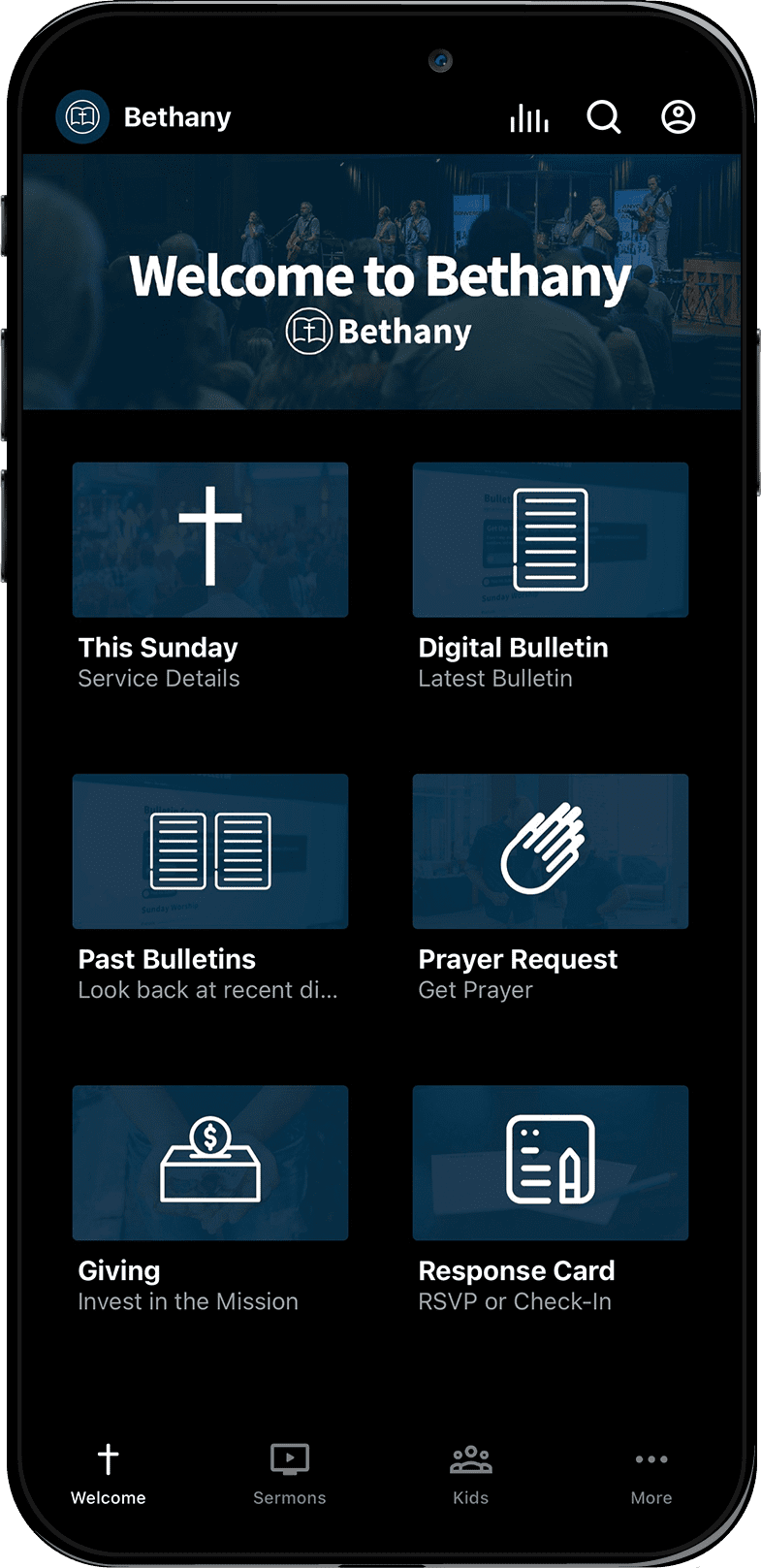

- 1Watch the Latest Sermons
- 2Get the Digital Bulletin
- 3Tell us how to pray for you
- 4Get updates and notifications
Tell Us How to Pray for You
Fill out a prayer request form and we'll be praying for you.Get Updates and Notifications
Get real-time cancellations & notifications from the church.Download Now