

In This Series
Encourage!
June 27, 2021 By
Dr. Ritch Boerckel
Acknowledge Him!
June 20, 2021 By
Dr. Ritch Boerckel
Testify!
June 13, 2021 By
Dr. Ritch Boerckel
Shift in Perspective
June 6, 2021 By
Claude White
Ordinary Ministry, Extraordinary God
May 30, 2021 By
Josh Beakley
Transformation!
May 23, 2021 By
Dr. Ritch Boerckel
Conversion!
May 16, 2021 By
Dr. Ritch Boerckel
Divine Appointments
May 9, 2021 By
Josh Beakley
The Devastation of False Faith
May 2, 2021 By
Dr. Ritch Boerckel
The Death of Death
April 25, 2021 By
Dr. Ritch Boerckel
The Old Testament Takes The Stand
April 18, 2021 By
Daniel Sheaffer
The Christ-Centered Life
March 28, 2021 By
Dr. Ritch Boerckel
The Main Thing
March 21, 2021 By
Josh Beakley
Unstoppable
March 14, 2021 By
Josh Beakley
Deception Among God’s People
February 28, 2021 By
Dr. Ritch Boerckel
The Fruit of Rejection for Christ
February 21, 2021 By
Dr. Ritch Boerckel
The Blessing of Rejection
February 14, 2021 By
Dr. Ritch Boerckel
Jesus Continues His Ministry
February 7, 2021 By
Dr. Ritch Boerckel
The Fellowship of The King
January 31, 2021 By
Daniel Sheaffer
Preaching Jesus
January 24, 2021 By
Dr. Ritch Boerckel
The Spirit Arrives!
January 17, 2021 By
Dr. Ritch Boerckel
Stick to the Plan
January 10, 2021 By
Dr. Ritch Boerckel
Looking Ahead
January 3, 2021 By
Dr. Ritch Boerckel
The Main Thing: Maintaining God’s Priorities
Acts 6:1-7 (ESV)
March 21, 2021
Pastor Josh Beakley
1 Now in these days when the disciples were increasing in number, a complaint by the Hellenists arose against the Hebrews because their widows were being neglected in the daily distribution. 2 And the twelve summoned the full number of the disciples and said, “It is not right that we should give up preaching the word of God to serve tables. 3 Therefore, brothers, pick out from among you seven men of good repute, full of the Spirit and of wisdom, whom we will appoint to this duty. 4 But we will devote ourselves to prayer and to the ministry of the word.” 5 And what they said pleased the whole gathering, and they chose Stephen, a man full of faith and of the Holy Spirit, and Philip, and Prochorus, and Nicanor, and Timon, and Parmenas, and Nicolaus, a proselyte of Antioch. 6 These they set before the apostles, and they prayed and laid their hands on them. 7 And the word of God continued to increase, and the number of the disciples multiplied greatly in Jerusalem, and a great many of the priests became obedient to the faith.
Belgium was in danger. German forces were closing in on Brussels. Over a quarter of Germany’s tank force was deployed to attack this city in the north. So to address that rising threat, reinforcement was sent to the Dyle River, just east of this northern city, as a core focus of French and British efforts. Everyone was to protect Belgium, gathering at Dyle. Only, there is a problem. The German troops that were striking in the north belonged to army group B. It was the secondary force. Nearly 100 miles to the south, Group A was using tanks that were newer, heavier, and almost twice in number to execute the primary attack against Sedan to invade France. The lesser threat at the Dyle had depleted crucial ally energy, at great strategic cost. The battle at the river appeared won, but at too high a price for the greater picture in the war. There is a battle tactic known as diversion. It’s the act of drawing away attention and the forces of an enemy from the point of principle operation; distraction, diversion.
God is on the move. In the cosmic battle, it seemed at times as if He had lost the upper hand. He sent His Son, come as the God-man in the flesh, and was on an unstoppable surge. He advanced God’s Word. He was disturbing the establishment, healing the sick. He was giving sight to the blind, casting out demons, evading political traps, and gathering an untold following throughout the region. Then suddenly, He is betrayed by His own, abandoned to scourging, and executed on a cross as a criminal. But all this was according to plan.
Just like He promised, He rose from the grave and his followers re-gathered. They were energized, mobilized, ready to move on with their raised leader. But again, a surprise occurred. He says He must return to heaven and that they will continue the work. It’s another apparent set back, and yet, He won’t leave them alone. As He goes up, according to plan, He will send the Holy Spirit, the helper, to be with them. The nature of spiritual warfare changes in a drastic way. The Gospel mission of God continues just like He promised.
The movement grows and it faces new obstacles now. There is corruption from within through the lies of Ananias and Sapphira. There is persecution from without from the Sadducees and the Sanhedrin. Both challenges they’ve survived. It reminds us of God’s people moving in the Exodus. You see the opposition. Then you see in chapter 6, they face another dangerous threat; diversion. At their very core, distraction.
It’s one of the greatest threats any movement can face. It would deplete the core energy away from the primary mission and leave it vulnerable to collapse. It’s one of the most deceptive threats because it draws us into a battle over very important things. And that’s the allure. We get drawn in because we fail to notice the biggest threat to the mission, which oftentimes actually is surprising. The biggest threat to the most important things is sometimes being distracted by very important things. We could say it like this. Very important things can pose a serious threat to the most important things. We see that truth unfold in our passage. If we want to avoid being drawn into diversions and losing sight of the gospel mission of God, then we need to be convinced of that and let that point sink into our own hearts and maintain what’s most important to God in a way that is faithful and appropriate. One of the ways that we can grasp that truth is by coming to a few basic realizations. So we’ll look today at a few of those realizations; just four simple reminders to help us maintain what matters to God and avoid these enemy tactics of diversion. First, let’s look at
Growing Pains/A Complaint Arises (1)
What to Expect—The True Difficulties of Real Life
This Jesus-movement has already faced some difficulty; corruption and persecution. Now we see diversion. You can see that the diversion happened as they experienced growing pains and this complaint arises in verse 1.
1 Now in these days when the disciples were increasing in number, a complaint by the Hellenists arose against the Hebrews because their widows were being neglected in the daily distribution.
This is a serious complaint that the needs of the Grecian widows were being neglected in favor of those of the Hebraic widows. This is a real life difficulty. A difficulty means something that is hard to accomplish or deal with or understand. We know life has difficulties. Sometimes we overlook how messy things can get. We have these rose-colored glasses and they filter out the challenges of real life.
We glamorize home-ownership, overlooking the challenges of a failed sewage-ejector pump or the squishy carpet of a flooded basement. Not that I’m speaking from personal experience. (Laughter!) We sentimentalize parenting, until we’re up past midnight buying staples for a science project due on Tuesday morning. We idolize career progress, without recalling the project that was denied three times. We have these lapses in clarity. Sometimes they’re just God’s mercy, to keep us from collapsing at how hard life can be. But sometimes they distort our vision for what kind of reality we should expect to encounter. That leaves us vulnerable to discouragement and diversion from the mission. Because we even romanticize ministry and church life. We expect it to be just easy and full of glory until we read that email or the text message or the online post that talks about the benevolence ministry neglecting minority widows. That’s real life difficulty.
For all the idyllic descriptions of the early followers of Jesus, it’s clear from Acts 6 that just like us, the early church was not immune to the difficulties of real life. This is a key reminder that helps us stay on target, on mission. Even when God is on the move, we should expect to encounter true difficulties. As you think about this topic, there are a few factors to keep in mind that we can anticipate and prepare for. Let’s look at a couple. First, you can see the factor of fresh complaints. In verse 1,
a complaint by the Hellenists arose
This word for complaint is a lot like the English word “grumble.” It’s kind of intended to sound like what it means. It’s this idea of a murmur or a grumble, grumble, grumble. The Greek is gongusmos; gongusmos, gongusmos. You can hear the whisper happening around you. It’s the complaining that takes place within the early church. It’s the same word that is used in some of the quotes of grumbling in Numbers. Despite the manifest presence of the Holy Spirit, the experience of miracles and healings, despite the preaching of the actual apostles, this complaint arose, even in the early church because in a fallen world, there is real life, real people, and real difficulties. One of those factors is fresh complaints that continue to arise. It’s nothing new.
Complaints arose from God’s people in Egypt. They arose in the wilderness and beyond. Many of these complaints happened in times of real challenges. But the way that they were expressed often took the form of a complaint that was hurtful. It was difficult for the entire gathering. Sometimes people expressed disappointments respectfully. Sometimes they spread throughout a community and there was this undercurrent of murmuring whispers and messages. You can see this complaint. As soon as one complaint is put down, a fresh one is ready to rise to the surface.
I think it was last year that the Better Business Bureau received over a million complaints. I think almost 200,000 remain unsettled. And next year, there will be another million. There are so many concerns. It’s not to say that they’re all invalid. It’s just to say that no matter who we are, even if we’re an apostle, or Jesus, or leaders in today’s world, we should expect to encounter difficulties in real life, and even fresh complaints. Whether we’re the one by whom, against whom, for whom, or to whom this kind of a complaint is made, no matter what’s going on, it would do us well to stay composed. Recognize that this is something to anticipate.
You see another factor here is natural complexity. It’s not so surprising that complaints would arise, but what’s startling is when they arise; the context in which they occur. You might be tempted to think, “Sure, things will be tough when we’re not doing well, when we’re not really preaching the gospel, we’re not really advancing, when God’s not on the move. That’s when there will be a complaint. But if the Spirit is moving, then we should be immune.” But verse 1 proves that’s not the case. You see the difficulty of natural complexity.
1 Now in these days when the disciples were increasing in number,
Things were going well. This is the first time in the book of Acts when the word “disciple” is used. Mission is happening. Matthew 28 is unfolding. God is moving.
The context here is not necessarily harmful. It’s actually helpful. You don’t have to be doing something wrong to encounter difficulty. In fact, sometimes it means you’re doing something right. Natural complexity is a real issue.
You think about a movement that is experiencing growing pains and dealing with that kind of scaling, and how do you handle the challenges even in its infancy? It could have collapsed this entire movement, and yet, God is at work through these leaders. It’s helpful for us to escape the illusion that we would be immune from challenges in times of growth or the burden that any difficulty must mean we’ve abandoned the mission. I think there is a call for us to be realistic about the difficulties we’ll face because of natural complexity.
But there is also something else that we see happening here. We see an underlying conflict. You can see who this complaint arises through, the parties involved, in verse 1.
a complaint by the Hellenists arose against the Hebrews
Now there are mixed opinions here on exactly who these terms describe. I think my best and simplest understanding is that both groups were Jewish, but the Hellenists were Jews who had come to be shaped by Greek culture and language, where the Hebrews were the Jews who held to a culture and language more traditionally Hebrew, Aramaic. One explanation as to how this occurred was that after the fall of Israel, there were many Jews. They had spread throughout many nations and they had adapted to various cultures and languages. One of the most prevalent was the Greek culture. So in their later years, several of these Jews would come back to Jerusalem to be able to reconnect and then to die and be buried in Jerusalem. But the result is that there are many widows that begin to have a home in Jerusalem, and to have needs. So you see these widows are a part of the Christian movement, where there are widows in both of these cultures that are happening. And the widows are experiencing some provision from the church. But a complaint arises. This complaint sort of exposes this underlying conflict that is happening.
Now we would like to imagine that there was perfect treatment and care in the church, that there was no partiality and that there was no division, no underlying conflicts. We’d like to imagine that is the case today, but the Scriptures tell us a story that is far less polished. We see constant warnings in churches of all kinds to beware partiality, beware divisions, enmity, strife, judgments, rudeness, cultural insensitivity of selfishness. We see these warnings. Some of this is because of general sinful nature, but sometimes there is a recognition of underlying conflicts. It seems to be what is highlighted here.
There is some kind of underlying conflict and there appears to be two parties here; what seems to be an aggrieved minority and an unaffected majority. There is a sense in which one side is likely to express the concern, the other side likely to overlook it. We know that by human nature. Yet, Luke is very careful not to push and put too many details here. He is careful not to get too involved. He acknowledges and recognizes that there is an issue going on. But there is a sobriety, a respect, and he doesn’t dive deep into those issues. We recognize it would be foolish to disregard the nature of this complaint. There is something going on that we should be careful about. But there is an underlying conflict that we should be careful not to oversimplify.
Then you can see, lastly, there is a compelling concern in verse 1. They were complaining
because their widows were being neglected in the daily distribution.
It’s thought that this was sort of an allotment of money or food to care for those in need, widows in particular. It’s a biblical theme to care for widows and this was in question, here. So the church is trying to step in and people had brought funds to the apostles to distribute. Then due to the conversions, there is a larger and more complex operation. Somehow, grumbling is surfacing because of what appears to the Hellenists as apparent neglect.
My best understanding is that it is unclear about how valid this concern is. It could be valid. But what’s even more unclear is whether or not it was intentional. It’s hard to believe that it isn’t in some way, there is an issue going on. But Luke is careful not to step into the issue too deeply. But even if there was partiality happening or there was a difference happening, a question here about fairness, we’re not sure what would cause it, whether it was due to language barriers or maybe some kind of logistical challenge that lead to a disproportionate effect to one party. We’re not told. Luke doesn’t go into it. But what we can see is the concern definitely comes at us in a very compelling way. Neglect of widows? It’s deeply emotional, as is often in the cases of the difficulty of real life. It’s deeply emotional. Whether it’s someone’s mother or aunt or grandmother, they’re emotional about this and the concern is very compelling. We see what’s happening. It’s another factor in the difficulties of real life. All these things are going on; complaints and complexity, conflict, concerns.
To just zoom out, we can just say they proved a point. Difficulties are to be expected. In Acts 6, the early church, even the apostles, they faced difficulties. There were difficult and messy situations going on. In fact, Jesus Himself faced complaints, even about providing food, at times. He was never partial, never overlooked the outcast. In fact, He Himself was viewed as a nobody and an outcast. But if we see that difficulties arise for the apostles, the early church, even Jesus, then we should be ready to expect difficulties ourselves. If we think that we can navigate God’s mission without difficulty, we’re going to have wildly unmet expectations and be drawn into all sorts of distractions to try to achieve a state of perfection that we were never promised to experience. We need to be careful and expect these difficulties and anticipate them and stay composed. Whether we’re leaders receiving those complaints or we’re members trying to express those complaints, we need to not be like the world. The call for us as a church is to be gracious, kind, caring, forgiving. Colossians 3 tells us of the heart we’re to have.
Colossians 3:12–13 Put on then, as God’s chosen ones, holy and beloved, compassionate hearts, kindness, humility, meekness, and patience, bearing with one another and, if one has a complaint against another, forgiving each other; as the Lord has forgiven you, so you also must forgive.
As the complexities unfold, we can be realistic about the fact that this doesn’t necessarily mean we’re doing everything wrong. It could be that we’re doing things right. We need wisdom. We need to recognize there are underlying conflicts and we need to be careful. We need to recognize that the Gospel doesn’t eliminate our distinctions, but it does unify and harmonize us together. The great equalizer, the common ground is Christ and the cross. Paul would emphasize that in Galatians chapter 3. He says
Galatians 3:26 for in Christ Jesus you are all sons of God, through faith.
Galatians 3:28-29 There is neither Jew nor Greek, there is neither slave nor free, there is no male and female, for you are all one in Christ Jesus.
He’s not eliminating those distinctions, but he’s recognizing that there is a unity now in Christ that we have to live out together. The way that we live that out even in a messy, difficult, real-life world is through a heart of love. Romans 12:15 would talk about rejoicing with those who rejoice and weeping with those who weep.
1 Corinthians 12:26 If one member suffers, all suffer together; if one member is honored, all rejoice together.
1 Peter 3:8 Finally, all of you, have unity of mind, sympathy, brotherly love, a tender
heart, and a humble mind.
Philippians 2:3 Do nothing from selfish ambition or conceit, but in humility count others more significant than yourselves.
Whenever you have a conflict and a difficulty, it’s so easy to think that this would all be solved if they just did that. But the Scriptures constantly point us toward ourselves. It says
Philippians 2:4-5 Let each of you look not only to his own interests, but also to the interests of others. Have this mind among yourselves, which is yours in Christ Jesus,
We expect difficulties, but the Gospel transforms the way we face them and we enter into them with love. But if we fail to expect these difficulties, we will fail to protect the priorities.
The Main Thing/The Priority Is Protected (2, 4)
What to Protect—The Firm Priority of God’s Leaders
Amid this arising complaint, a priority is protected.
2 And the twelve summoned the full number of the disciples and said, “It is not right that we should give up preaching the word of God to serve tables.
4 But we will devote ourselves to prayer and to the ministry of the word.”
It’s a firm priority to be protected. Priority means something that is most important or precedes all the others. It doesn’t necessarily mean that it happens first. It just means that it’s the last to go. This is the key, the core.
It was quite a while ago. I believe we were traveling back to America after some years oversees, and my Dad spots this fast food restaurant that he had eaten at and missed. I’ll change the name to protect the guilty. We’ll call this place Jerry’s Chicken. He walks over. You know the familiar logo. You can smell the aroma, the enticing menu, the friendly employee. Everything is going right. There’s just one problem. Jerry’s Chicken was out of chicken. (Laughter!) They had napkins, forks, fries, drinks, everything, just no chicken. That’s a problem because it was Jerry’s Chicken. Of all the things that Jerry could be short on and be forgiven, the one thing that was unavoidably disappointing is the absence of chicken.
It seems funny, but how many so-called Christian churches have open doors, welcome teams, professional marketing, skilled staff, and fail to communicate the message of Christ? Far, far too many. How many pastors, that’s a word connected to the idea of shepherd, fail to do what the Good Shepherd calls His under-shepherds to do; “Feed my sheep.” How many church bodies emphasize the multiplicity of gifts and yet fail to listen to the Head, who is Christ? It’s easy to get lost in temporal success, all of the difficulties, to find a simpler way, to find a guaranteed way. We will get lost if we don’t tenaciously defend the chief priority. This passage forces us to realize how important it is and gives us a few ideas on how we can to do it as a church.
There are a few agreements as a church that we can make to protect God’s priority. The first is to agree on the essential duties that we’re to defend for God’s leaders. It’s what we protect.
4 But we will devote ourselves to prayer and to the ministry of the word.”
You could say prayer and Scripture. It is talking to God about people and talking to people about God. These are the essential duties of the shepherd. They are purposely distinctive. They are spiritual in nature. It’s communicating on behalf of men to God and on behalf of God to men, not as a priestly mediator in an Old Testament sense, but as a pastoral ambassador. It’s one who cares for the flock. They emphasize themselves.
4 But we will devote ourselves
As the shepherds, the apostles, the leaders, they recognize that they need to focus, to dedicate, to devote themselves to prayer and Scripture. These go together. All throughout the Bible we see that prayer and the Word go together. Whether it was Samuel or Christ or Paul or the apostles, this is moving prayer and Scripture. Shepherds need to be committed to this. It’s a priority to protect. It’s an essential duty to defend. And as a church, we need to agree upon that.
It’s also one of the things that makes the local church different than a favorite podcast or a preacher around the nation. Because in a local church, to the best of their ability, you have shepherds who are seeking to pray for the sheep by name. You have shepherds who are being shaped and transformed and changed through those prayers as they think and have to apply Scriptures to their own lives and to the community that we work together for the glory of God. There is something mysterious and something profound and something vital in that work; the ministry of prayer and Scripture.
It’s happening in all sorts of ways. It happens through preparation of a sermon, through dispensing the sermon, through prayer here in the congregation, through prayer that is happening all throughout the hallways on a Sunday, on phone calls, of prayers throughout the week, prayers in a weekday email that goes out, Together Day by Day. We have prayers where people come in and ask the elders to come and pray and they share their burdens before us. And that shapes the way that I have to wrestle with the text and Pastor Ritch wrestles with the text. For anyone who comes and brings God’s Word, the people of God are on your mind and heart. I get the privilege of seeing some of these shepherds have tears as they pray for the people. We need to defend those essential duties.
The world is not going to celebrate those. The world is going to say, “Wait a second! You went there and you listened to a guy talk? How long did that guy talk? He talked a long time. Last week it was a long time! You’re just talking? And then he goes and he talks to God? It’s just talking.” The thing is, we gather, and we don’t gather to hear a person talk. We don’t gather to say, “I’m here to hear so and so talk.” We gather to hear God. And I hope we leave having heard from God. These are the essential duties. We recognize this. The call is so different from the world, but it’s a call to devote to Scripture and prayer.
Second, we see the pressing distractions that we’re to resist. We can sense the danger that there are distractions. The apostles say in verse 2
“It is not right that we should give up preaching the word of God to serve tables.
The idea here is that it’s not pleasing. It’s not what God wants. It’s not desirable to Him to give up the ministry of the Word for the ministry of service, here. It’s not a statement that the apostles devalue the importance of material service or to say that they’re above certain menial tasks. We know that Jesus Himself washed His disciples’ feet and said, “Be like this. Do like this.” Paul, when he was talking to the elders in Acts, he said, “With my own two hands I did stuff. I served. You saw me.” So it’s not to say that we’re above that or a leader is above that. Leaders are to be servants. It is a statement not about being above certain tasks, but being devoted to specific tasks.
The disciples, the money was being laid at their feet. They were helping to oversee these things, but at some point, the organization had grown complex enough that they had to choose. They’re recognizing this task must be done. We have a responsibility before God and this actually is going to distract us. The emphasis in the Greek is not that they shouldn’t serve, but that they shouldn’t serve tables. That word “tables” is not specifically just dealing with service of a meal, per se. It’s dealing with the idea of benevolence, whether it’s a food or fund. They’re just saying, “We shouldn’t be devoted to this. We need to be devoted to the ministry of the Word and have someone else step into this role.” They are protecting and recognizing that this is a distraction away from the thing that was critical that the church had, which is food from God. We need as a church, to hear from God.
It doesn’t mean that there is only one ministry or one ministry only matters. The body is diverse. Everyone needs to do their part and be a part of the work and use their gifts. But for the leaders, we need to recognize this priority and avoid the distraction. We need to sense the danger that that distraction brings, that threatens us all.
You see that it’s shared through a common dedication. It’s a common dedication where we share this burden.
2 And the twelve summoned the full number of the disciples
It was the whole group. All the congregation gathered together. The phrase “the twelve” is the only time it is used here in this book. It is highlighting that everybody gathered. They recognized this is a serious need for all of us to understand this priority. They agree. It’s a dedication that we agree to share. We’re going to make sure that prayer and Scripture are going to move forward and our entire family is going to be carrying out and ensure that that advances.
We protect the priority of God’s Word through, last, you can see a tactical delegation that we honor. The way that this happens starts in verse 3.
3 Therefore, brothers, pick out from among you seven men
We’re going to delegate. We’re going to get some people in here to help because this is a legitimate issue that we have to deal with. So this will be delegated. Pick out some men. They’re going to be identifiable. You pick them out. They’re going to be internal. They come from among you. They’re going to be reasonable in amount. They call for seven. It’s not a magic number. It’s just a reasonable amount to cover the need. The idea is that the delegation here is an important part of the church functioning. I think it was D. L. Moody who said that it was better to put ten men to work than to try to do the work of ten men. Recognize the way that the church body works together to select quality help. So they step into that. That’s part of how we protect these priorities as church leaders. It must be protected.
Jesus knew this well. Think about someone who could do the work of ten men. He could do the work of ten hospitals. He could just heal people. He was casting out demons. He was doing all this, and yet, He would go off to pray.
Mark 1:36–38 And Simon and those who were with him searched for him, and they found him and said to him, “Everyone is looking for you.” And he said to them, “Let us go on to the next town, that I may preach there also, for that is why I came out.”
He had His eyes set on the mission, on the chief goal; preaching. The Gospel mission of God is preaching the good news. Jesus was knowing that He would have to go to the cross. There were times that even His own apostles stepped in the way and He had to press forward. In Luke chapter 9, we’re told that He set His face toward Jerusalem, knowing He was going to save the world through this means. He was going to preach that means and pray for those people.
You see horses when they’re getting ready for a race and they put those blinders, those blinkers on, so they don’t see any other distractions. They’re prepared so that they can focus on the mission and avoid any distraction. Christ was pressing ahead towards this mission. As a church family, we recognize this gospel mission of God and we don’t lose sight of it. All the distractions that come are real difficulties, but we protect the priority. We understand the calling for the church to preach and the pastor especially to preach and to pray. We sense the danger of distractions that come. We share the burden to try to help. We select quality help to come in to advance that work. The next question is who?
Help Needed /A Ministry Begins (3, 5-6)
Who To Select—The Clear Strategy of God’s People
3 Therefore, brothers, pick out from among you seven men of good repute, full of the Spirit and of wisdom, whom we will appoint to this duty.
5 And what they said pleased the whole gathering, and they chose Stephen, a man full of faith and of the Holy Spirit, and Philip, and Prochorus, and Nicanor, and Timon, and Parmenas, and Nicolaus, a proselyte of Antioch. 6 These they set before the apostles, and they prayed and laid their hands on them.
The clear strategy unfolds. It’s the strategy by which these individuals are selected. We can see that even though the church is an organism, it still requires organization. In the early church, they recognized that and they issue some criteria that kind of strategically screens these leaders. This is some criteria that we can learn from. The first is to select people that are truly qualified.
3 Therefore, brothers, pick out from among you seven men of good repute, full of the Spirit and of wisdom, whom we will appoint to this duty.
They are people who are respectable in their reputation. They are spiritual in their lifestyle. They are to be full of the Spirit, yielding to His control, skillful in their ability. Also, they are to be full of wisdom and able to apply knowledge that relates to the issues at hand. They are accountable to the task, appointed to the duty. They’re accountable. So here they are: respectable, spiritual, skillful, accountable, given to this duty. They are truly qualified. The apostles are delegating responsibly, but also thoughtfully.
Here is maybe a more indirect point, but the example is I think, noted. These are selected because they’re practically suited to meet the issue.
5 And what they said pleased the whole gathering, and they chose Stephen, a man full of faith and of the Holy Spirit, and Philip, and Prochorus, and Nicanor, and Timon, and Parmenas, and Nicolaus, a proselyte of Antioch.
You see that these seven men are chosen. We might easily overlook it, but the names of each of these men is a Greek name. Each of these men at least have some kind of connection to Greek culture, at least in their names. Then at the last, Nicolaus, you see is a proselyte of Antioch. We get the sense that in the cities some distance away, there is a hint that the gospel is striking at the heart of Gentile territory. We recognize that somehow, the apostles had not emphasized the culture. They had not emphasized a quota of some kind. They emphasized the character. Now, God worked through the congregation in such a way that they identified, nominated, and honored leaders who are truly qualified and well-suited. It’s hard to know whether or not these men could speak Greek. Maybe they were more familiar with certain customs. Whatever it was, it made them to be well-suited to help the church care for all the widows. Whatever it is, this is how God works. There seems to be a sense in which these are well-suited to the issue at hand. In fact, these lesser known Greek believers are going to take center stage in the next couple of chapters. These are the individuals selected.
Now there is a question here about this passage because there is an office that is mentioned later on in 1 Timothy chapter 3 about being a deacon. Here at Bethany, we understand the Scripture also to have the idea of a deaconess as well; Romans 16 and that passage in 1 Timothy 3. There is a debate among many about Acts chapter 6 and whether or not this is the initiation of that idea of deacons. It’s a legitimate position to hold. The principle of that pairing of material and spiritual ministry seems to be here in the kernel, for sure. But I think there is a sense of nuance as the church is developing and growing. These men, especially Stephen and Philip, are strong speakers and evangelists. We want to be careful not to force people into certain molds and recognize that God was working and moving.
The word “service,” that same word for deacon, which is service, is used throughout the passage. People are serving. The call is that the church would work together with wisdom. We see that wisdom unfold over the course of Scripture, to involve the office of elder and deacon, and we believe deaconess. It’s to have individuals who are both bringing the spiritual nature of ministry, but also caring for some of those logistical details of ministry. They are intertwined, but there is some clarity further on.
That’s part of why we seek to pray for and raise up more leaders. You can pray for and consider this passage among many as you think about the leaders that we have and read their testimonies. We have new deacons and deaconesses who are seeking to serve the Lord. You can pray for them. You can seek to encourage them and also evaluate leaders constantly, according to criteria like this and elsewhere, praying for God to bring the people that we need, to serve this strategy that He has given so that we can protect the priorities and do what God has called us to do.
Jesus was a master of delegation. He recognized the need for structure even within an organism. We recognize that here, to try to delegate both responsibly and thoughtfully about the people that we’re seeking to equip for ministry. And to recognize, sometimes there are differences. Hopefully it’s not a difference theological or philosophical, but sometimes there is a difference cultural or linguistical or musical that we adapt and we let God work through His people. We need wisdom on how to do that. There are ways that we try to partner and minister with people who are unlike us and people who share a common bond in Christ and even within our own community.
There is an opportunity where we’re partnering with Grace Baptist, where we’re learning and there are differences. We can actually encourage one another. One of the ways that we’re going to do that is through a Good Friday service. We have a Good Friday service that I believe is at noon on Good Friday. We’ll have a service later on at 7:00 pm, but we also have a noon service where they’re going to come and partner with us in some of those elements of speaking and in music. There is a lot of beauty and learning and growth in the ways that we try to advance God’s Gospel together. There is a clear strategy that He has given to us. How does this all work?
Slow And Steady/A Movement Spreads (7)
How It Works—The Sure Reliability of God’s Word
There are a lot of questions that we would have and details that we want that are not given to us, but we can see how it begins and ends. It focuses on how it works; through the sure reliability of God’s Word.
7 And the word of God continued to increase, and the number of the disciples multiplied greatly in Jerusalem, and a great many of the priests became obedient to the faith.
What a testimony to the impact of Gospel mission! God’s Word works so reliably to secure His will. It’s trustworthy. It does what He desires it to do. Think about the challenge that they faced. This could have totally collapsed this movement. We experience these kinds of challenges today and it can be very disruptive. But we take great assurance and confidence in the reliability of God’s Word to work. That’s something worth celebrating. Think about the way God’s Word works. Here are a few reminders.
First, it’s mysteriously active. In verse 7, it just says “the word of God.” The Word of God is what is moving, here. It’s not just like a preacher or an apostle or some super person. It’s just the Word of God. The Scriptures and the simple Gospel message is alive! It is God-breathed, in His own time, in His own way. There is nothing quite like this book. God knows that. This is the kind of book that you don’t only read it, it reads you. It’s mysteriously active and has been since the beginning of creation. The power of the Word in new creation is now through the Son, God manifested in the flesh. Hebrews 4:12 would say it like this:
Hebrews 4:12–13 For the word of God is living and active, sharper than any two-edged sword, piercing to the division of soul and of spirit, of joints and of marrow, and
discerning the thoughts and intentions of the heart. And no creature is hidden from his sight, but all are naked and exposed to the eyes of him to whom we must give account.
It’s mysteriously active. That’s why Paul would say
2 Corinthians 4:2 But we have renounced disgraceful, underhanded ways. We refuse to
practice cunning or to tamper with God’s word, but by the open statement of the truth we would commend ourselves to everyone’s conscience in the sight of God.
I don’t have to do anything. I’m just telling you the truth. God will do the work. People will resist it. They will reject it. Yet, it’s mysteriously active and it is relentlessly consistent.
7 And the word of God continued to increase, and the number of the disciples multiplied greatly in Jerusalem,
It brings to mind that parable of Jesus of the seed being sown. And it continues to spread and move and multiply, carried forth by God’s Spirit. He says in Isaiah 55,
Isaiah 55:10–11 “For as the rain and the snow come down from heaven and do not return there but water the earth, making it bring forth and sprout, giving seed to the sower and bread to the eater, so shall my word be that goes out from my mouth; it shall not return to me empty, but it shall accomplish that which I purpose, and shall succeed in the thing for which I sent it.
God brings it about! It is relentlessly consistent. Paul would be in prison and he would say,
2 Timothy 2:9 for which I am suffering, bound with chains as a criminal. But the word of God is not bound!
And then last, it’s undeniably impactful.
and a great many of the priests became obedient to the faith.
It’s amazing! After all the setbacks and animosity, all the persecution and even the problems within, all of a sudden, now the priests are coming to the faith. They’re seeing miraculously how God is working even through these cultural divisions. It’s amazing! We see that the followers of Jesus are doing exactly as He commanded and God’s power is at work and the mission is moving. It’s here in Jerusalem and it’s about to spill over into Samaria and move to the ends of the earth. They’ve never seen anything like it. God is on the move and He’s just getting started, here. The priests recognize that and they step in. The conversion is amazing! We see the Word of God bearing fruit, as Paul would say in Colossians 1. The whole world is bearing fruit and increasing. We can expect great things from God and His Word. It reminds me of Luke 24. It’s the same author, here.
In Luke 24, he talks about the followers of Jesus who were walking on the road and they came across Jesus. They didn’t recognize He was there and He said
Luke 24:25–27 And he said to them, “O foolish ones, and slow of heart to believe all that the prophets have spoken! Was it not necessary that the Christ should suffer these things and enter into his glory?” And beginning with Moses and all the Prophets, he interpreted to them in all the Scriptures the things concerning himself.
Luke 24:31-32 And their eyes were opened, and they recognized him. And he vanished from their sight. They said to each other, “Did not our hearts burn within us while he talked to us on the road, while he opened to us the Scriptures?”
Have you ever felt your heart on fire from the Word of God? If you are a follower of Christ, you must have. If you have not, you should take serious consideration of the state of your soul because that’s what God’s Word does. It sets us on fire. You might say, “Yes, I felt that yesterday. I felt that this morning.” You might say, “I haven’t felt that in a long time.” What’s changed? God’s Word hasn’t changed. There’s a work that He does through His Holy Spirit and we want to have soft hearts that are open to Him working.
I remember great seasons of life, not that every season is all the same, experientially on fire. But there is a sense of trust and seeing God’s Word at work. I remember that as a young man. I remember now as a dad, we’re reading the Bible. We’re walking through family devotions. A lot of nights, the kids are just distracted and you’re just trying to make it to bed. But there was one night we were walking through 1 Samuel and my kids were just kind of catching the power of what’s going on. Their eyes were opened up and they were kind of on the edge of their seats. They’re seeing God work to save His people. Their attention is there. then one of the kids just sort of blurts out, “I love reading the Bible!” (Laugher!) It’s a good moment for a pastor, and not just a pastor, but for a father because I know what she’s talking about. She was seeing the glory of Christ, I believe.
That’s what you see when you let the Word of God do its work. His Word is completely reliable. Is it touching your heart? Let it take root. Let it bear fruit. Let it transform you from within and let’s send it out to the world around us. Jesus said in John 14
John 14:12–14 “Truly, truly, I say to you, whoever believes in me will also do the works that I do; and greater works than these will he do, because I am going to the Father.
Whatever you ask in my name, this I will do, that the Father may be glorified in the
Son. If you ask me anything in my name, I will do it.
We recognize that we’re sowing seed and there is a work that is multiplying here and that we’re a part of. God is continuing on the move. We want to be a part of God bringing about His Gospel mission. These realizations help us stay on track and not get diverted through very difficult things in life.
I think it was one of those business guys, Stephen Covey who said, “The main thing, is to keep the main thing, the main thing.” There’s nothing new about that principle. The early followers of Jesus got it right. The question is, will we?
Latest Sermon Series







Get the App
Watch the Latest Sermon
Get access to each week's sermon right on your phone. Look up sermons & series.Get the Digital Bulletin
Get the latest updates, events, & family news by checking out the digital bulletin.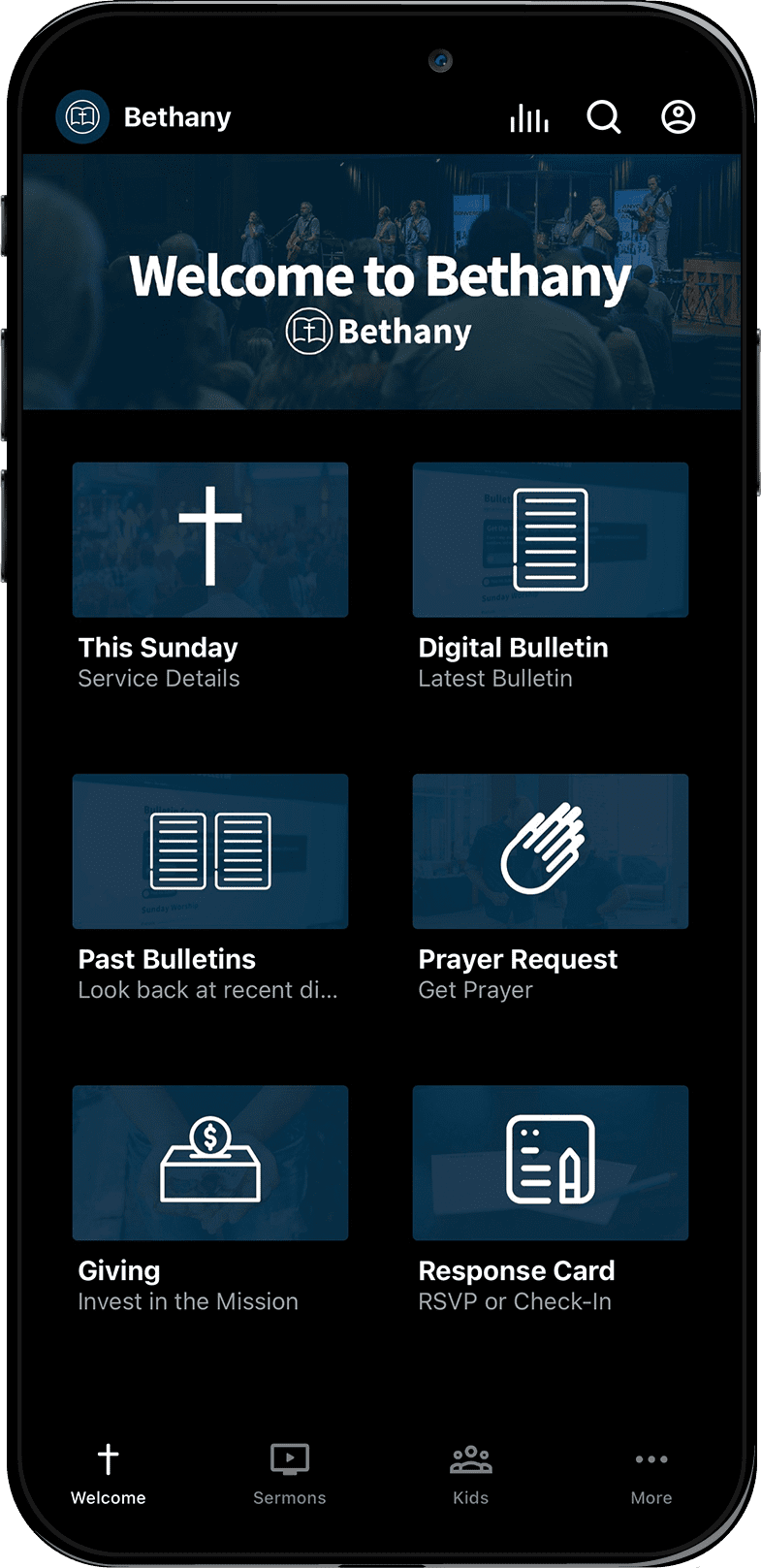

- 1Watch the Latest Sermons
- 2Get the Digital Bulletin
- 3Tell us how to pray for you
- 4Get updates and notifications
Tell Us How to Pray for You
Fill out a prayer request form and we'll be praying for you.Get Updates and Notifications
Get real-time cancellations & notifications from the church.Download Now