

April 19, 2026
Gospel Blessing
Preaching Galatians 3:1-9, Pastor Rich frames legalism as a subtle, more dangerous kind of backsliding — not the obvious moral relapse into past sin, but sliding away from grace and the power of the Spirit back into self-effort and law-keeping. He defines legalism as a misuse of God's good law that relies on the law instead of Jesus for justification and instead of the Holy Spirit for sanctification, and calls it not merely mistaken but demonic ('who has bewitched you?'). Three threads from the text show the better way: the believer's first-hand vision of Christ crucified (illustrated through Isaac Watts's 'When I Survey the Wondrous Cross'); the reception of the Holy Spirit by hearing with faith, not works of the law; and sanctification as the Spirit's ongoing work, not the flesh's striving (illustrated by the Interpreter's House in Bunyan's 'Pilgrim's Progress,' where the law stirs up dust but the gospel lays it with water). Having begun by faith, we are to keep living by faith — an active, personal dependence on the Holy Spirit to grow us toward Christlikeness.
In This Series
Gospel Love
June 14, 2026 By
Dr. Ritch Boerckel
Gospel Freedom
June 7, 2026 By
Josh Beakley
Gospel Illustration
May 31, 2026 By
Dr. Ritch Boerckel
Gospel Longing
May 24, 2026 By
Dr. Ritch Boerckel
Gospel Adoption
May 17, 2026 By
Josh Beakley
Gospel Guardianship
May 10, 2026 By
Dr. Ritch Boerckel
Gospel Promise
May 3, 2026 By
Kyler Bell
Gospel Redemption
April 26, 2026 By
Josh Beakley
Gospel Blessing
April 19, 2026 By
Dr. Ritch Boerckel
Gospel Rebirth
April 12, 2026 By
Dr. Ritch Boerckel
Gospel Justification
March 29, 2026 By
Dr. Ritch Boerckel
Gospel Confrontation
March 22, 2026 By
Dr. Ritch Boerckel
Gospel Unity
February 22, 2026 By
Daniel Sheaffer
Gospel Transformation
February 15, 2026 By
Dr. Ritch Boerckel
Gospel Drift
February 8, 2026 By
Josh Beakley
Gospel Commission
February 1, 2026 By
Dr. Ritch Boerckel
Let's pray again. Let's start over. Father, thank you for Jesus. Thank you for this precious family at Bethany. Lord, help us to love you, to walk with you, to be changed by you. We pray this in Jesus' name. Amen. I was sharing that God placed me in a family that loved Jesus and that really lived for Him, lived by faith, and it was real. It was real, not just on Sundays, but every day. So as such, my mom and dad, they would read the Bible often and explain what it meant and how it applied.
They would talk about the gospel. They'd talk about this message of Jesus coming and dying on the cross and raising the third day, ascending to heaven. He's going to come again and they demonstrated then gospel living to us by the way they lived their lives. Again, not perfectly, but truly, genuinely. And they engaged in gospel worship and service as well, ministry to the Lord with us. If you are one of those who grew up in a home like this, then I would say it is right for us to thank God for this added blessing. It's not a blessing that very many get to have, and I know many of you were not in that kind of home. And so if you were, remember to thank God for it. There's tremendous privilege that comes from that. And if you are married with children, you are right also to seek the Lord to give this blessing to your children.
So, my dad didn't grow up in a home like that. He didn't grow up in a home that was Christian or had the reality of faith, and yet God gave him the blessing to be a dad to children and express Christ in a very real, powerful way. One of the ways that my family followed Jesus was in the devotion to fellowship in Jesus' church. As a young boy, I sat with my parents almost every Sunday morning and every Sunday evening in church. I sang hymns with my dad and my mom. I listened to more sermons than I can recount. I arrived early to fill communion cups with my mom in the church kitchen. Following Jesus meant that the local church is central in our lives. We understood that that was the Bible's teaching, and it is. My first pastor was more of an evangelist than he was a Bible teacher.
This had its advantages, and it had its disadvantages. In addition to the key sermon themes of heaven and hell, the cross of Jesus, the need to repent and believe in Jesus as Savior, the pastor would often talk about the danger of backsliding. That word backsliding, it's not used very often anymore, at least not in my spiritual circles. So when the pastor talked about backsliders, I remember being confused as to the exact meaning. I remember thinking, "Whatever it was, it was not good." At first, I thought the pastor was talking about the people sitting up in the balcony at the back of the church. I looked back there and said, "Do they know he's talking about them?" Eventually, I came to realize that the pastor was really talking about believers who at one time lived in obedience to the Lord's commands, but then somewhere along, reengaged with past sin. So perhaps in becoming a Christian, a drunkard stops drinking alcohol, but then after some times goes back to it. Or perhaps, in becoming a Christian, a person repents of sexual sin and begins to live a pure life, but then at some point reengages in sexual immorality.
To be sure, this kind of backsliding was a problem for Christians back in the 1960s, and it is a kind of backsliding that's still a problem for believers today. Satan labors in every generation and culture to move God's people back into various sins. Yet there is another kind of backsliding that Paul talks about here in Galatians 3. This kind of backsliding is even more common and more corrupting than the moral kind of backsliding. Paul warns in Galatians 3 about sliding back away from grace and going back into legalism. Paul warns about sliding back away from the power of the Spirit and back into the power of self-effort. This kind of backsliding is harder to see because the external manifestations aren't as obvious. But it's the kind of backsliding that actually reaches deeper into our soul and moves us, and potentially a whole church, away from the gospel. The main idea we're going to trace today through Galatians 3 is that having begun our life with God through faith in Jesus, let us live our new life by faith. The path to spiritual growth is not paved with the stones of our own efforts to obey the law.
Good efforts they may be, but the path to spiritual growth is not paved with our own efforts to simply obey the law. But this path is paved with our walking by faith in the Spirit. So we're going to talk about this danger of legalism today. I think it is a major theme of this whole letter, and first let's consider the deception of legalism. So this letter confronts directly the false teaching that Paul calls a different gospel in chapter 1, verse 6. This altered gospel sounds very similar to the authentic gospel, but it is distorted. It is twisted. It is undone. This false gospel flows into the Galatian church through some professing believers, people who say, "I'm a follower of Jesus," who arrive to the region of Galatia from Jerusalem And Paul uses then, in this letter and elsewhere, the strongest language to describe these men. In chapter one, verse nine, he calls these men accursed.
In chapter two, verse four, Paul calls them false brothers. In chapter two, verse six, he calls them influential. In chapter two, verse 12, he calls them the circumcision party. In Philippians 3:2, he calls them dogs and evildoers. So Paul is making his point very clear that these are really, really dangerous and wicked people. In Acts 15, God gives us a helpful short description of these false teachers' teaching. Luke writes, "But some men came down from Judea and were teaching the brothers, 'Unless you are circumcised according to the custom of Moses, you can't be saved.'" So in order to be saved, you need to go back to the law and begin to live your life under the authority of Moses' law. After Paul and Barnabas had no small dissension and debate with them, and then the story unfolds about how there was a church council that happened, I believe right before Paul writes this letter to the churches in Galatia. Today, the word that many use to describe these teachers is legalists.
Legalists. The teaching they espouse is called legalism. In order to benefit from Genesis 3, let's answer the question, what exactly is legalism? Let's get a definition. So legalism is a misuse of God's good and perfect law. Legalism relies on the law instead of Jesus to be accepted as righteous by God. But more to the point of Galatians 3, legalism relies on the law instead of the Holy Spirit to become righteous in our daily lives. Legalism destroys both the truth about our justification as well as the truth about our sanctification. So if you use God's law correctly, the law will teach us that our own sin has produced such a failing that we cannot amend our ways back into God's good graces. The law will teach us, if we use it rightly, that we need a savior.
We need Jesus, the Messiah, to resolve this big problem we have with sin. So a right use of the law shines a spotlight on the dark recesses of our hearts to unveil the depth of our sin and the wickedness of our sin, and to convict us that God's judgment is certain. If we look down at Galatians 3:24, we read, "So then, the law was our guardian until Christ came." So it uses the word guardian. Other translations read our tutor. In order that we might be justified by faith. So the law was helpful, it's good. It showed us that we could never, ever accomplish justification, acceptance by God, declaration of righteousness over our life through the law. It showed us that we needed a Messiah. Now that faith has come, we're no longer under a guardian.
We don't need the tutoring that the law gave to us, for in Christ Jesus and Messiah Jesus, you are all sons of God through faith. Through faith. So the law is acting sort of as the nanny or a tutor raising up young children to teach us that our sin is a huge problem, that we're going to face certain judgment, and that we don't have the capacity in ourselves to justify ourselves or to sanctify ourselves. And so what Paul is addressing here, and really throughout this whole letter, is that the law cannot be mixed with the gospel. It not simply must not be, but it cannot be. These two don't mix. One will always destroy the other when we try to mix them. So the law cannot be mixed with the gospel to accomplish the miracle we need. Whenever the law is mixed with the gospel, then the miracle is not performed. The false teachers in Galatia are mixing law with gospel.
It's not that they're wholly rejecting the gospel. It's that they're saying we need to add to this gospel of grace, this emphasis upon works of the law. And with this problem of legalism in view, Paul responds, look at verse one. Look at what he says to these Galatian believers. "Oh, foolish Galatians." He's not read Andrew Carnegie's "How to Win Friends and Influence People," because he just simply says, "Hey, I'm going to cut it straight here. I know you're going to be offended by it. Oh, foolish Galatians." And then he asks this question that's even more offensive. "Who has bewitched you?"
You see the false teachers, the who, are not merely mistaken. They're people who are actively working to bewitch believers in Jesus' church. That is, to cast a spell over, a demonic spell over the hearts of God's people. These teachers have an agenda to confuse the minds of Jesus' disciples in order to lead them astray from worship, and in order to lead them out of the life of God in the Spirit. In using the term bewitched, Paul is emphasizing the demonic origin of those who are teaching them. This is a term that is connected with the occult. Now, Paul has seen the occult at work in his missionary journeys. He's seen Satan's direct attacks on Jesus' church. He knows what a bewitching looks like, and he says, "This has all the marks of a demonic activity in this church. Who has bewitched you? Who has cast a spell over you?"
In the midst of this problem, the Apostle Paul launches a theological grenade into the heart of legalism, into the heart of this false teaching. He says that legalism is not merely wrong, it is demonic. It's not that, hey, there's just a little bit of tweaking on some of your doctrinal statement that you need. No, this is Satan actively working in this church to destroy this church. Did you know that Satan is not afraid to enter into Jesus's church to teach legalism to God's people? Did you know that? He wasn't afraid to do that in the 1st century. He's not afraid to do it in the 21st century. He's bold about it. In fact, it's one of Satan's most influential means to corrupt and destroy a church.
The Galatian believers, now they're responsible. Just because they were bewitched doesn't mean they're not responsible for what's happening to them. They're responsible for listening to and submitting to the false teaching. So Paul calls them foolish because they should've known better, because they'd already received the true gospel, and they should've recognized the danger that this false gospel posed. Then here's the application. If we have heard and received the true gospel, God does hold us responsible for what we give our ears to hear and our hearts to believe. So just listening to some interesting podcast, it's not innocent. In other words, God says you're going to be held responsible for what you're giving your ears over to hear and what you're giving your hearts over to receive. And it's not going to be any wonder that we are led so far astray from the gospel when we give our ears over and our hearts over to false teaching. That says that you're foolish.
You're foolish. And he's bewildered by this backsliding of this precious group of people he loves, who he was the instrument in planting these churches and bringing them the gospel. And he's bewildered by their backsliding from the true gospel into legalism. Receiving false teaching is not a sign of open-mindedness. It's a symptom of rebellion. Now, we have an open heart and open mind, and what does an open heart and mind, its purpose is similar to an open mouth, and that's to close it on something good. And if we have an open mind, and we hear the truth of the gospel, now it's closed on the gospel. We don't have to go back and say, "I wonder if this gospel is true. I wonder if there's another gospel out there." If it's good, and if you've already experienced it, you know it's good.
Why do you go back and say, "Oh, I need to keep an open mind to every false teaching?" It's dangerous, Apostle Paul says. And he's bewildered by it, and he writes with astonishment. It was before your eyes that Jesus Christ was publicly portrayed as crucified. So he says, "Before your eyes." It's interesting. Every believer sees the crucifixion of Jesus, the Messiah. That's what he's saying. Part of God unveiling his glory to us in the face of Jesus is a vision that he gives to his people, a vision of Jesus's death on the cross. The cross is central to the gospel.
It's central to this active miracle that works in our heart. In order for us to receive this miracle and to embrace Jesus by faith, God gives us a vision through the preaching of the gospel of Jesus's death on the cross. Remember, the Galatians were not physically at the crucifixion of Jesus, and yet he speaks to them in verse one as though they are. They were not in Jerusalem on that first Good Friday, but it was before their eyes. He's using a physical language to describe a spiritual means of receiving Jesus. It's the eyes, not of their physical eyes in their head, but the eyes of their heart that they see. It's before their eyes. They're the eyes of their spirit that Jesus is publicly portrayed as crucified. So the preaching of the gospel, it's not merely a nice lesson in theology and nice interesting moment in history, but the preaching of the gospel is a real presentation of the person of Jesus in his death, his burial, his resurrection. And as such, the gospel causes the person blind to God's glory to see God's glory, and where is God more glorified than in the death and resurrection of his Son?
The gospel causes us, who hear and believe, to personally experience a first-hand encounter with the crucifixion of Jesus. It is as though we can say, "It's before my eyes, too, that Jesus was publicly crucified." And if you're a believer in Jesus, I think that you can say, "I can resonate with that." Maybe to different levels for some of us, but we say, "I can resonate with that. I have seen the crucified Christ." I think that's what communion helps us with. One of my favorite hymns is one written by Isaac Watts in 1711. Wouldn't you love to be part of the church when he introduced this song? So Isaac Watts grew up in a pastor's home, and he grew up loving the Lord. His dad loved the Lord.
He listened to his dad. He loved his dad, and he loved the gospel. He loved Jesus. But one thing that young Isaac didn't love as he became a teenager, he didn't love church music. Is that a shock? He didn't love church music, and he would complain about it to his dad. He'd come home after Sunday mornings and complain about church music. "You know that it's devoid of life. It's not resonating in my heart. There's something wrong with it."
And so his dad finally said, "Isaac, you got to stop complaining. It's wrong to grumble and complain all the time. Instead, why don't you do something about it? Why don't you write a song that gives praise to God?" Isaac said, "I'll do that." He took it up as a challenge. He wrote a song, and the next Sunday, his dad's church sang it. A new song that he wrote. We don't have that song today, but it was a new song, and some of the members, they loved it. Some of the members didn't like it at allAnd that was true all through Isaac Watts's life.
He wrote over 750 hymns. And on this one in particular, this one that I'm referencing, "When I Survey the Wondrous Cross," some people at church says, "All this new church music, it's so self-centered." It's talking about when I survey the wondrous cross. Do we have anything happen like that 300 years later? But Watts echoes this truth that Paul is writing about in Galatians 3:1 when he says, "When I survey the wondrous cross." The word survey means a deep, long look. It is a personal gaze. It is not a glance or a quick scan, but a subtle consideration that brings a clear vision. It's the kind of look that changes us when we are given it. It's the kind of look that changes us that once we see Christ crucified, we can't leave that being the same.
And this is what he wrote. He says, "When I survey the wondrous cross on which the Prince of Glory died, my richest gain I count but loss." He says, "It stirs in my soul. I realize everything I thought was important in life, it's turned upside down, and I pour contempt on all my pride. There's nothing that I can do to gain God's pleasure." And then he says, "See?" And he's inviting us through this song. "See, look with the eyes of your faith. See from his head, his hands, his feet, sorrow and love flow mingled down. Did ever such love and sorrow meet or thorns compose so rich a crown?"
I remember when I was a little boy, again, Jesus was publicly portrayed through me through the gospel, through this song. And I remember this very song. I remember just being touched as I saw when I was invited to see, I was able, as a little boy, to see. I envisioned Christ dying for me. It was a real experience. He was publicly portrayed, as Paul says. And then Watts closes, "Were the whole realm of nature mine, that were a present far too small, love so amazing, so divine, it demands my soul, my life, my all.[1]" So the legalist says, "Look to the law." And the gospel says, "No, look to Christ and Him crucified and risen." So where do I find victory over my sin?
Do I find victory over my sin by looking more to the law, or do I find victory over my sin by looking to Christ crucified? Here's the truth. If we live our lives by looking to the law to help us to live a righteous life, then sin will be our master. That's the outcome of looking to the law. But thank God we're not under law, but we're under grace. It was before your eyes that Jesus Christ was publicly portrayed as crucified. Now let's talk about the reception of the Holy Spirit. Look at verse two. "Let me ask you only this." And he takes them back, and he's undoing the works of the law, and he's exalting this hearing with faith, this work of grace that's received by faith in Jesus.
And so he says, "Let me ask you a number of questions. Did you receive the Spirit by works of the law or by hearing with faith?" So he's asking them to think back on their testimony of what happened when they came to faith in Christ. And this is going to be the first of many references that Paul makes to the Holy Spirit in this letter. After showing the conflict between justification by works of the law and justification by faith in Christ, those two are two radically different gospels, now Paul continues to hammer away at legalism by talking about the presence of the Holy Spirit in the life of the believers. It's a different angle to attack the same problem. And so he says, "Let me ask you only this. Did you receive the Spirit by works of the law or by hearing with faith?" So the gift of the Holy Spirit is one of the greatest blessings we receive when we place our faith in Jesus. The Holy Spirit is given to us as God's gift to help us.
He is called our helper. And as our helper, He is one that Jesus promises to send to us after He ascends up to heaven. He says that in that upper room in John 14. He says, "I'm going to ask the Father." They're all disturbed that He told them He's going to go away, and He says, "But here, I'm going to ask the Father, and He will give you another helper." He's talking about the Holy Spirit. "And He's going to be with you forever. And you're going to know Him, know Him personally, even as you know me, for He dwells now with you, but He is going to dwell in you. He's going to be in you. There's going to be a change of His ministry after I ascend to the Father."
So the gift of the Holy Spirit is one of the greatest blessings we receive. And this gift of the Holy Spirit, it's central to the gospel message. So in Acts 2, when we hear the first sermon that the church preaches through Peter, after the Holy Spirit descends and indwells followers of Jesus, here's what the sermon says. This is the first sermon. It's fundamental in its nature. It's the gospel. "Repent and be baptized, every one of you, in the name of Christ Jesus for the forgiveness of your sins." And here's the gospel promise, "And you're going to receive the gift of the Holy Spirit." This gift is offered to every person who believes in Jesus. Now, later, when Peter is sharing the gospel with the Gentiles in Cornelius's home in Caesarea, here's what happens.
"While Peter was still saying these things, the Holy Spirit fell on all." He's with Gentiles now, with Cornelius and Cornelius's friends and family. Cornelius is a Gentile. "And the Holy Spirit fell on all who heard the word. And the believers from among the circumcised who had come with Peter, they were amazed, because the gift of the Holy Spirit had been poured out even on the Gentiles." So the presence of the Holy Spirit in the soul of the believer is our most clear evidence of God's salvation. In Romans chapter eight, we read, "The Spirit himself bears witness." This is evidence because now this indwelling presence, the Holy Spirit, it's a real thing. He's a real person, and he speaks to us. He says, "You're a child of God now because you have Jesus as your Savior, as your Messiah, as your King."
John's going to write, "By this, we know that we abide in him and he in us because he's given us of his Spirit." We have an experience of knowing the Spirit of God when we come to faith in Christ. Now, the gift of God's Spirit does not come to us sometime after we believe in Jesus, but at the moment of our faith in Jesus for salvation. Friends, beware of any teaching that highlights some special requirement in order to receive the fullness of the Holy Spirit. All such added efforts are a form of works righteousness. It's a form of legalism. There are various different groups have different prerequisites for what that works righteousness is, but every one of it that says, "Hey, you can have a more full measure of the Holy Spirit if you do A, B, or C," beware. All such added efforts are a form of works righteousness, and these take our eyes off of Jesus, who is the one who gives the Spirit, off of Jesus' accomplishment for us, and causes us to backslide into focusing upon something we can do in order to have this experience. So again, Paul asks, "Did any of you receive the gift of the indwelling Spirit as a result of doing anything, as a result of obeying Moses' law?" And the answer, they all know it.
Their testimony is clear. "Nope, nope. We didn't do anything to earn the Holy Spirit." Then Paul asks, "Or did you receive the gift of the Spirit by hearing the gospel and responding in faith?" And the answer, "Yeah, that's exactly how we received the Holy Spirit, by hearing the gospel and receiving Jesus by faith." Friends, I would ask you, have you received the gift of the Holy Spirit? Because every person who is a child of God through faith in Jesus has received the gift of the Holy Spirit. And I want you to ask in your own soul, have I received the gift of the Holy Spirit? And if you say, "I'm not sure if I have," then I would say it's really important for you to pray over that. I would say talk to a spiritual shepherd, an elder in the church, some Christian friend about that, because you do not want to be unclear regarding your own salvation, and it is the presence of the Holy Spirit that is the guarantee of our salvation.
The sanctification by the Spirit now. Look at verse three. "Are you so foolish? Having begun by the Spirit, are you now being perfected by the flesh?" So we need to keep ourselves in the gospel and away from placing our feet on the foundation of the law from the beginning of our Christian life and all the way through to the end of our Christian life, when we die or when Jesus returns. We will stop growing in Christlikeness if we follow the advice of these legalists. We will rob ourselves of spiritual power to become more like Jesus if we step on the foundation of the law and not on the foundation of God's grace through Jesus. Now, this word perfected. You notice that, are you now being perfected by the flesh? It means to mature, to grow toward completion or toward full maturity.
It's a reference to our sanctification. Sanctification is the work of God's Holy Spirit in the believer's life. This work separates us from sin, and this work grows us upward toward true holiness in practical, everyday life. But it is an ongoing work of God's Spirit that begins on the day that we come to faith in Christ and then continues in its progress, never reaching completion until the day we see Jesus face to face. The Apostle Paul uses this word in Philippians 1. He says, "I'm sure of this, that he who began a good work in you when you came to faith, he justified you, he adopted you into his family, he placed his Spirit inside of you, he who began a good work in you," what? "Will bring it to completion, will bring it to perfection." Same word. He's going to complete it at the day of Jesus Christ. So it's very important that we not confuse justification with sanctification.
Every believer is justified to the exact same degree. If you look around across this big group of church family, there's no one says, "I think that person is a little bit more justified than that person over here." That's not true, okay? Every one of us have been declared righteous to the exact same degree. We are absolutely accepted to the same measure that every other believer is accepted in the beloved. Each of us, however, grow differently in holiness in different degrees and different measures. The problem with legalism is not that the legalist makes too much of obedience to God. The gospel makes so much regarding obedience to the Lord. Christ gave himself in love to his church to sanctify her, to wash her, to purify her, to grow us more and more in Christlikeness. The problem with legalism is that legalists place too much emphasis on self-effort of the flesh and too little emphasis upon the power of the Holy Spirit.
Our sanctification is the fruit of the Holy Spirit's work inside our soul. And again, Paul asks, "Are you so foolish to believe that after having been justified by faith in Jesus, that now you're sanctified by works of the law?" And that's where a lot of believers are. Many believers pass over the part of the stream that says, "No, I know that I'm justified by faith alone." But then that stream curls around and we have to walk over again. But I think that my sanctification requires me to go back and look at the law. It goes back to look and have self-effort in order to continue down this path of growing in Christ-likeness. And that's what the Apostle Paul is asking. Are you so foolish to believe that after having begun by faith, that you can continue on and be perfected by works of the law? Satan designs to diffuse the power of the Holy Spirit in the believer's life, and he knows that if we embrace legalism, he will cut us off from the only power source we have to grow in Christ-likeness, to experience this miracle.
The truth is, we are foolish to believe that we are justified by the Spirit's gracious work in us and yet sanctified by our own efforts to obey God's law. Our ability to grow in true holiness does not flow from our efforts, but from our active dependence upon the Holy Spirit. In Galatians 5, we're going to dig into this much more deeply, but the Apostle Paul simply says, "Here's what I say. Walk by the Spirit and you won't gratify the desires of the flesh. For the desires of the flesh, they're always against the Spirit. The desires of the Spirit, they're always against the flesh, for these are opposed to each other. But if you are led by the Spirit, you're not going to be under the law. You're not going to be overpowered by sin." And then he goes on to say, "But here's the fruit of the Spirit." The fruit of the Spirit of someone who's walking by the Spirit, who's being led by the Spirit, it's love and joy and peace and patience and kindness and goodness and faithfulness and gentleness and self-control.
This is the image of Christ that he's lifting up, and this is what the Spirit is doing in the life of his people. So again, the gospel is not less concerned than legalism about practical holiness. The gospel simply charts a different path to holiness. The Holy Spirit is at work in the Christian to give us new desires, new motivations, and new empowerment. So look at verse five. "Does he who supplies the Spirit to you and works miracles among you do so by works of the law or by hearing with faith?" He repeats that little line, "By works of the law or by hearing with faith?" The Galatians experienced miracles, and we can read about those miracles in Acts 14. One of them is a man crippled from birth is able to walk. But I also think he's still talking about this miracle of sanctification, this miracle of being changed.
And so how is a miracle, if we need a miracle, and it is a miracle anytime we can overcome some sin habit, every time we can have a change of direction of our own natural thinking, every time that we can love God and love people rather than being distant from God and kind of embittered toward people. We all need a miracle for that. And so he's asking the question: How is a miracle going to happen in your life? It's going to happen because you have the Ten Commandments written on your kitchen. You say, "I'm going to obey these Ten Commandments. I'm going to obey the Ten Commandments. I'm going to obey the Ten Commandments." Are the Ten Commandments bad? No, they're good. But the purpose is, I'm undone.
I'm not able to obey them. So now I need something else. I need Jesus who's my Messiah, and when I receive Jesus as my Messiah, he actually gives me the gift of His Holy Spirit to indwell me so I can live a miraculous kind of life. Here's what Colossians 2 says, "Therefore, as you have received Christ Jesus the Lord, so walk in Him." You received Him by faith in Christ. Now walk in Him by faith in Christ, knowing that Christ is the one who's going to enable us through His Spirit, rooted and built up in Him with established faith. One of the books that I commend to you, it's an old-timey book, is the book "Pilgrim's Progress," written by John Bunyan.[2] And there's part of it, I just want to share a little part of it, where Pilgrim, his name is Christian. He's on the path. So he's passed through, he's been justified, he received Jesus by faith.
He's not at the celestial city yet. He's not in heaven. He's on the path. It's a struggle. There are all these hardships. It's such a great book to know what to expect in our path of growing in Christ, growing in practical righteousness. And on the path, he comes to this house. It's called the Interpreter's House because he's really confused about this walk and this path and how to stay on the path, and I want to read this little section. "So then the interpreter took Christian by the hand and led him into a very large parlor room in his house, and this parlor room, it was filled with dust. It was never swept. The which after he had looked at it a little while, the interpreter called in for a man to come and sweep."
So here they are looking at this parlor. It's filled up with dust. The interpreter says, "Hey, come on in here and sweep. It needs to be cleaned up." Now, when he began to sweep, the dust began so abundantly to fly about that the Christian had almost been choked by the dust. So all that happened, sweep, sweep, sweep. You get this picture. Dust flies up. Coughing. Then said the interpreter to a girl that stood by, "Hey, bring over some water and sprinkle it on the floor."
And that's what she did. She brought some water, and she sprinkled on the floor. And once that was done, then the room was swept and cleansed with ease. Catch the picture? You know its meaning? Well, the Christian didn't know the meaning, and he says, "What does this mean?" And so the interpreter says this, I love his answer: "The parlor is the heart of a man that was never made pure by the sweet grace of the gospel. The dust is his sin and inward evils that have defiled the whole man. He that began to sweep at first is the law, but she that brought water and did sprinkle it is the gospel. Now, whereas you saw that as soon as the first began to sweep, the dust did so fly about the room that it could not by him be cleansed, but that you were almost choked by the dust. This is to show you that the law, instead of cleansing the heart by its working from sin, rather revives sin, puts strength into sin and increases sin in the soul, even as it does discover and forbid sin, for it doesn't have any power to overcome it. Again, when you saw the girl sprinkle the room with water upon which it was cleansed with ease, this is to show you that when the gospel comes in the sweet and gracious power thereof to the heart, then I say, even as you saw the young girl lay the dust by sprinkling the floor with water, so is sin vanquished and subdued and the soul made clean through the faith of it. And consequently, that soul is fit for the King of glory to dwell in."
Isn't that beautiful? There's much to say about the subject of sanctification, and we're going to continue on this subject as we walk through this letter together. But I want us to close here by just thinking about this little phrase, by hearing with faith. Remember, he used it twice at the end of verse two and at the end of verse five. He says, "Does this happen by works of the law or by hearing with faith?" Does this happen by works of the law or by hearing with faith? So by hearing with faith, what does that mean? Many hear the word of God. They read it. They read it perhaps every day.
They listen to it taught in church. They've gone to Sunday school all their lives. They perhaps even memorize it. Perhaps they even teach it. So they hear the word, but they don't experience any real change from it. Is that possible? Well, notice the Pharisees. The Pharisees know more, especially of the Old Testament, than I will ever know. They memorized it almost completely. I've not memorized it, and yet there was no change.
So it's not the hearing that makes the difference, it's the hearing with faith. Every Sunday, we have the opportunity to hear the word, and if we only hear it without faith, without having faith energized and activated in our soul, we'll leave here without much change. But if we receive it with faith, there's always a dramatic impact. It always nourishes us. It always strengthens us. It always transforms us. So it is faith that enables us to experience this maturing, this perfection that the gospel promises. It's the hearing with faith. So what is faith? Thought about that question, and I just want to give you some thoughts about what faith is, what biblical faith is.
So what biblical faith is not. Biblical faith is not a doctrinal affirmation. It's not hoping that something good will happen in the future. Biblical faith is not a past decision that we made. Biblical faith is not reciting a prayer. Biblical faith is not a striving for spiritual accomplishment. Biblical faith is not fatalistically accepting hard trials, and biblical faith is not embracing passivity and inactivity. So what is biblical faith? Biblical faith, and I want to emphasize this, it's an active and personal, so it's real to you, but it's active. It's not just sitting in some corner passive.
It's active and personal reliance on God to do everything he promises to do. It is an active and personal grasping onto God like Jacob wrestling with him. "I'm not going to let you go until you bless me." It's an active and personal entrusting of our life into Jesus' hands. It's an active and personal coming to Jesus. We hear his invitation. "Come to me, all you who are weak and heavy laden." And we come to Jesus to receive his love and sufficient provision. Biblical faith is an active and personal turning from sin and repentance, and it is an active and personal dependence upon the Holy Spirit to produce the fruit of true righteousness in us. In us.
Does the gospel remove all personal effort toward growth and Christ-likeness? And the answer is no. The gospel makes us alive so that our new life can move toward Jesus. Our faith is not inactive, but our faith walks daily with Christ, and we seek his grace to overcome our battle. We always have him in view, and we always have the Holy Spirit presence participating with our own interaction with our daily life. We recognize we need him. We need to depend upon him. Our salvation includes both our justification and our sanctification, and these are two different parts of the exact same miracle, and it's really important for us to be able to discern between the difference of the two. In short, and I'll leave you with this short consideration, justification happens wholly by faith. We're dead in our sins.
We can take no other action than to receive God's blessing, and justification is the work of God accomplished for us on the cross of Christ that is a gift of being declared righteous. And it is a completed absolute gift offered to anyone who believes in Jesus. And I would ask you, have you been justified? Have you been declared righteous? Have your sins been washed away? Sanctification, on the other hand, is an ongoing progressive work of God that comes to us by faith as we actively depend upon the Holy Spirit. It does include our striving. It does include our fighting. It does include our running. It does include action in our soul, but it's action that's rooted not in our own strength.
I'm going to do better. I'm going to change my own life. I'm going to improve. But it's rooted, I need Jesus. I need to have Him near me. I need the Holy Spirit, and to walk by the Holy Spirit, and to listen to the Holy Spirit, and not quench the Holy Spirit in my life. And it is ongoing all the way until the day we die or until the day that Jesus comes. And on that day, our sanctification will be complete. What a day that will be. If you have not yet been justified, the only question I ask is, will you believe in Jesus to be your Savior?
And I'd ask you that right now so that you can be part of God's family, receive the free gift of eternal life. For those who of you have been justified, I'm going to ask you, are you intent on growing in Christ-likeness, in pursuing the perfection, the maturing, the completion of God's eternal destiny for you right now? And if you are, then look up to Christ and depend upon His Spirit. We need Him. Amen and amen. Let's pray. Father in heaven, thank you. Thank you that the gospel carries the grace of justification and the grace of sanctification. I pray, oh, Father, you'd help us to discern the difference between the two. I help us, you'd also to discern the difference between works of the law and hearing by faith.
Oh, Father, we want to be people in whom you unleash your miracle, and we know you unleash your miracle in the hearts of those who hear your gospel, receive Jesus by faith, and actively then depend upon Him moment by moment. Father, we need you. We need you to do this miracle in our lives. We are not enough. We need Jesus Christ to be our Messiah and our God. Father, Lord, please revive us again for the sake of your name. Amen. Amen.
Referenced in this sermon
Latest Sermon Series






Get the App
Watch the Latest Sermon
Get access to each week's sermon right on your phone. Look up sermons & series.Get the Digital Bulletin
Get the latest updates, events, & family news by checking out the digital bulletin.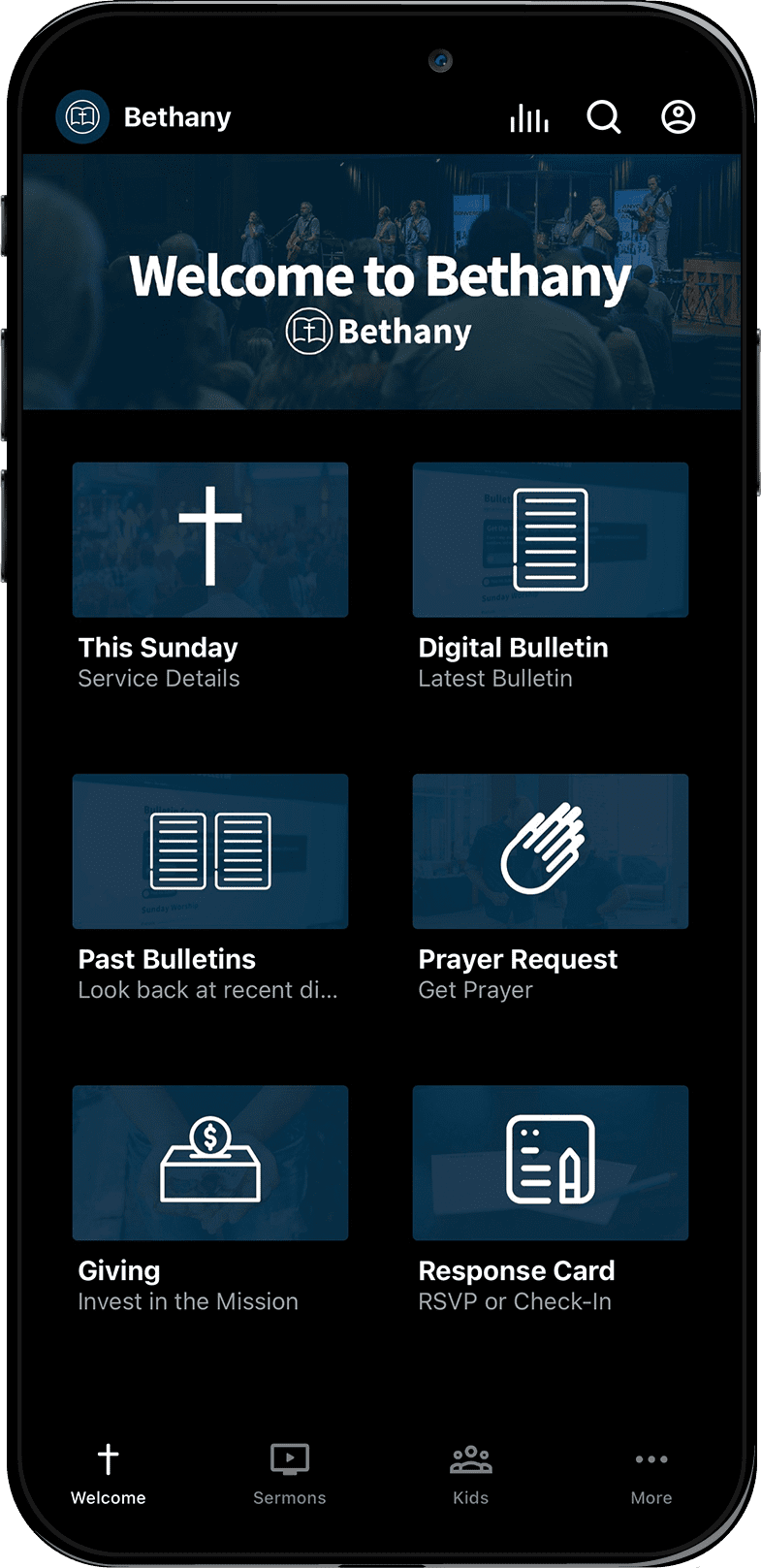

- 1Watch the Latest Sermons
- 2Get the Digital Bulletin
- 3Tell us how to pray for you
- 4Get updates and notifications
Tell Us How to Pray for You
Fill out a prayer request form and we'll be praying for you.Get Updates and Notifications
Get real-time cancellations & notifications from the church.Download Now